
Description
Speaker: Glenn Rawson
Hi, this is Glenn Rawson. One of the most powerful ways to share history and heritage is by the telling of stories. We began sharing inspiring stories nearly 30 years ago. Each of those stories is true and was intended to inspire and strengthen faith. Over the years, those stories have reached millions around the world. This podcast is for you to listen, learn and enjoy.
First Story (00:21) : Mary Ann Fenn Bird
Mary Ann Fenn Bird. This story, I hardly dare share very often, it’s too powerful. And even for some members of the church, it’s too much they can’t understand it. They can’t comprehend it, and it makes them angry, but I’m going to share it with you tonight. Let it cut where it will.
Mary Ann Fenn was born 14 April 1811 in Bedfordshire, England into a large and happy family. When she was 21 years old, she married Frederick Otto Bird and together, the two of them had seven children. Theirs was a happy life living in the rural village of Eaton Bray. In 1847, they were baptized and soon thereafter, their hearts were turned to Zion and gathered with the saints in Utah. It took the Birds’ years of preparation and just as they were about to depart to come to Zion, Frederick passed away suddenly.
Now a widow, Mary Ann and her seven children determined that they would still go on to Zion. And finally in April 1856, they left Liverpool on board the ship Thorn. They arrived in Iowa City. When they got there, Mary Ann’s, two oldest girls, hired out as servants locally to earn some money for the journey. Finally, August 15, 1856 all was ready, Mary Ann and her children ranging in age from 19 down to 5, left Iowa City as part of the Willie Company. Just before they left, two young local lads called on Mary Ann and pleaded with her not to make that trip, but to stay there and they would take care of them. But Mary Ann would not hear of it. They had not come this far at great sacrifice for their faith and they had come at great sacrifice and they would not stop now. They had not come all this way just to come all this way.
Well that first day, the handcart people did not journey very far. Only a few miles from Iowa City. The next morning, to everyone’s surprise, those same two young men called on Mary Ann again and asked her not to go. They said stay here we’ll take care of you. It becomes evident that their concern was less for Mary Ann and the children’s welfare, and more because of their interest in Mary Ann’s two oldest daughters. Well, Mary Ann’s answer was the same. We’re going on.
Unable to persuade her, the two young men asked permission to take Mary Ann’s two daughters – Ann and Sabina for a ride in their carriage to say goodbye. Mary Ann consented on the condition that the two girls and the foursome would be returned by nightfall. Come nightfall, they didn’t come back. She sat up and waited all night, but they never came back.
The next morning, Mary Ann faced what had to be one of the most difficult decisions of her life. Should she remain behind and go in search of the girls or go on with the company that would leave without her? With many heartaches and tears shed she went on with the Willie Company. Mary Ann would never see her daughters again in this life.
The journey of the Willie Handcart Company, as you know, is a legacy of faith, sacrifice, suffering, sorrow, but triumph. And none were these more evident than in Mary Ann Fen Bird. Her children were so small with the loss of these two girls that they could not keep up with the daily track of the company. Many evenings along the trail found Mary Ann’s family lagging behind and coming into camp at the very end. Many a night found Mary Ann weeping with sorrow at the choice of Ann and Sabina. But notwithstanding all they endured, they made it safely to Utah. Mary Ann’s legs and feet were frozen, frostbitten on the journey, and never quite healed. She died July 22, 1865, still bearing the open wounds of the journey with the Willie Company, but stalwart and firm in the faith.
Ten years later, Ann and Sabina came to Utah for a visit. Indeed, they had married the boys they ran off with, at each head born 10 children but their mother would not be there to greet them when they came. Now there are some not understanding, who might be tempted to find fault with Mary Ann Fenn Bird. But I am reminded of what the Lord said, “He that loveth son or daughter more than me, is not worthy of Me.”
Moreover, sacrifice brings forth the blessings of heaven. I can only imagine what kind of blessings, reward and legacy was passed on to Mary Ann’s family.
Second Story (06:33) : Sternness Was Our Only Salvation
Next story, much of my story has been about the Willie Handcart Company. Not all of it, but much of it and this is one more.
The advanced team of the rescue riders found the snowbound Willie Handcart Company on October 19th near the fifth crossing of the Sweetwater, high up on Wyoming plains. Those riders – Stephen W. Taylor, Joseph A. Young, Abel Garr and Daniel W. Jones.
As they reached them, they brought word that wagons were ahead. And indeed, wagon loads of those supplies reached the Willie Company on October 23 at Willie Meadows. Though they were found (and I say this all the time when I’m out there) ,though they were found, they were not yet rescued. The worst of the ordeal for the Willie Company was yet ahead of them. They still had to cross Rocky Ridge, they still must get through Rock Creek Hollow, they still had to go up and over South Pass at 7,550 feet in elevation. They were yet hundreds of miles from safety and shelter in Salt Lake City.
Among them was Michael Jensen and his family. They had come from Denmark. Michael describes a most, to some troubling, moment in their journey. Just beyond Rocky Ridge, he said, “My father was very weak from lack of food. And so the men in charge of the wagons fastened our handcart to one of the wagons and told father to hang on to the wagon. He was walking between our handcart and the wagon when he slipped and fell. And before anyone could reach him, his handcart had passed over him as he lay on the ground. They picked him up, put him into the wagon, and we went on until dark and then camped for the night. Sometime during that night. My father died. And the next morning, they buried him beside the road.”
I can remember well, he said, how sad we were. I was just 11 years old and my brother Anthony was only nine. And we could not say much to help our mother in her sorrow. Mother sat on a large kettle turned upside down weeping bitterly. I and Anthony stood beside her not knowing what to do. One of the men who was helping to manage the company came along just then. He had a walking stick in his hand. He struck mother across the back with this stick and said in a sharp voice. Get up and go on. You can’t sit here crying. We have to go on at once or we will all die.
Michael continued, “Oh how I wished I were a man and could fight for my mother. I never forgave this man.” And then he said, “Now, in my late years, as I look back, I see things more clearly. And I see that sternness was our only salvation and the only thing we could stand as it roused us from our misery. Had the leaders allowed us to grieve, we could not have endured the hardships left to us when we had to go on alone. Father died on the 29th of October, and we did not reach Salt Lake until November 11, 1856, which made us more than seven months from the time we had left Copenhagen.”
In that same area, a similar experience was shared by Agnes Caldwell. She said, “Just before we crossed the mountains, (meaning South Pass), relief wagons reached us, and it certainly was a relief. The infirm and the aged were allowed to ride, all able-bodied, continuing to walk. When the wagon started out, she said, a number of us children decided to see how long we could keep up with the wagons in hopes of being asked to ride. At least that’s what my great hope was, she said. But one by one, all the children fell out until I was the last one remaining. So determined was I that I should get a ride. After what seemed the longest run I ever made before or since, the driver of the wagon, William H. Kimball called me and said, Say sissy, would you like a ride? I answered in my very best manner. Yes, sir. At this point, he reached over, taking my hand and then clucking to his horses, made me run with legs that seemed to me could run no further. On we went to what to me seemed miles. What went through my head at the time, she said, was that this was the meanest man that ever lived, or that I’d ever heard of. And other things that would not be a credit, nor would it look well, coming from one so young, just at what seemed the breaking point, Kimball stopped taking a blanket, she said, he wrapped me up, and laid me in the bottom of the wagon, warm and comfortable.
And then she concludes with this. Here, “I had time to change my mind, as I surely did, knowing full well that by doing this means, in other words, making her run so far. She said he saved me from freezing, when I was taken into the wagon.”
Consider those two stories. Is there not an eternal lesson in them? Consider this, the unrelenting hardships of mortality. Stern as they are, may be the very whip across the back that saves us. And again, how many of you are holding on to the Lord’s hand and running for all you’re worth to keep up with the wagon of Zion in hopes that we will get rescued in the end and he just keeps making us run? Hang on. Keep running.
Third Story (13:39) : Catherine Curtis Spencer: The Joy of her Children
March 12, 1846, Indian Creek Camp near Keosauqua, Iowa, Catherine Curtis Spencer was very ill. Still weak from childbirth and afflicted by a severe cold, she sank lower and lower, growing weaker. For days it had rained in Iowa, rendering the prairies of Iowa an impassable mess of mud. What had brought this dear woman and tender mother here.
Catherine was born and reared in Massachusetts, the youngest daughter of a numerous family nurtured with fondness and peculiar care as the favorite of her father’s house. When she came of age, she married Orson Spencer, a man of great intellectual and spiritual gifts. Together, Orson and Catherine had six children. Over time, Catherine proved herself, “The glory of her husband, and the solace and joy of her children.”
When the Latter-Day Saints were preparing to leave Nauvoo for their journey to the west, Orson, in deference to his wife, wrote to Catherine’s parents asking if she might be able to come for an extended visit while he served as a missionary. In the meantime, a child was born to Orson and Catherine that lived only a short time and died. He was buried there in Nauvoo.
Then, February 4,1846, under the necessity of escaping the mobs and the federal government, members of the Church of Jesus Christ of Latter-Day Saints began crossing the Mississippi River for their journey to the Rocky Mountains. Orson and Catherine were among them. Not far into Iowa territory, the temperature plummeted to 12 degrees below zero. Then it warmed and began to rain, turning the roads into a quagmire. In the midst of these back and forth, soaked and miserable conditions, Catherine became ill and grew weaker. It seems, somewhere along the way, she began to sense that she would not live. She said to her children, “Oh, you dear little children, how I do hope you may fall into kind hands when I am gone.”
Then a letter came from Catherine’s parents, she asked her husband to read it to her. In that letter, her parents refused to allow her to visit and refused to render any aid or comfort, until Catherine denounced the religion that they so much detested. Catherine learned what her husband had tried to do to save her. Upon learning that she asked her husband to fetch the Bible, she asked him to read this passage out loud, he did. It comes from the book of Ruth, it reads,
“Entreat me not to leave thee, or to return from following after thee: for whither thou goest, I will go; and where thou lodgest, I will lodge: thy people shall be my people, and thy God my God: Where thou diest, will I die, and there will I be buried: the Lord do so to me, and more also, if aught but death part thee and me.” ~Ruth 1:16
Shortly after that, Catherine asked to see her children. She gave each of them a parting kiss, then turned to her grieving husband and said, “I love you more than ever, but you must let me go. I only want to live for your sake, and that of our children.”
Shortly after that, Catherine Curtis Spencer, died in peace, with a smile upon her countenance. She was 35 years old. A martyr to her faith. Orson returned to Nauvoo, and in the solitude of the night, buried her with her youngest child.
Those who knew Catherine said of her, “She was a kind mother to her beautiful children, a lady in every respect, and left a beautiful family.” The legacy of a loving mother, a martyr to the faith. Years later, Catherine’s daughter, Aurelia Spencer Rogers would organize the children of the primary. I think this is altogether fitting, to close.
Fourth Story: The Great Rescue
19:16
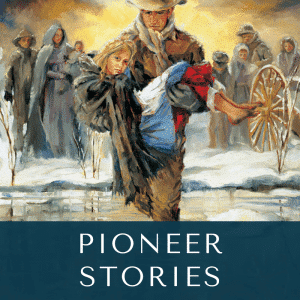
Tuesday, October 21, 1856, the members of the Willie Handcart Company were camped in the deep snow at the sixth crossing of the Sweetwater in Wyoming at the base of Rocky Ridge. They had been there for two days, and had run out of food. They had journeyed all the way from Iowa City, nearly a thousand miles pulling their handcarts. The last weeks of that journey had been against a deepening cold, ever reducing rations and inadequate clothing. Now, literally, the Willie Company was at their very end. They could go no further and we’re still 300 miles from civilization. One of them, William Woodward would later record, “It was a sorry sight, over 400 people with handcarts short of bedding, and to sleep on the cold ground, one thought is enough for a lifetime.”
John Chislett would describe the awful suffering in that camp. “Thus, it was enough to make the heavens weep. The recollection of it unmanned me even now, such craving hunger I never saw before and make God in His mercy, spare me the site again.”
Nine people had died in the camp the day before, and four more over the next two days. Then, just at sunset, the sound of wagons reached Willie Camp. It was the rescuers from the valley, sent by President Brigham Young. As they rode into camp, those who were able, struggled out of their beds to meet them.
One of those among the rescuers in the wagons was Harvey Cluff. He said, “Arriving within the confines of this immigrant camp, a most thrilling and touching scene was enacted, melting to tears the stoutest hearts. Young maidens and feeble old ladies threw off all restraint and freely embraced their deliverers, expressing in a flow of kisses, the gratitude which their tongues failed to utter. News spread throughout the camp like wildfire, and more turned out to greet the rescuers. Shouts of joy rent the air, said John Chislett. And strong men wept till tears ran freely down their furrowed and sunburned cheeks.
Seven year old Mary Harun recalled, “…as soon as the people could control their feelings, they all knelt down in the snow and gave thanks to God for his kindness and goodness unto them. They came just in time to save our lives.”
“The gratitude felt and expressed for those rescuers who had great sacrifices made, every effort going forward, to minister to the relief of the sufferers, was absolutely profound and inexpressible. May God ever bless them for their generous and unselfish kindness and manly fortitude”, said John Chislett.
The afflicted, said President Gordon B. Hinckley danced on frozen limbs with gladness for those who had come to rescue them.”
That rescue of the Willie, the Martin, and the Hunt and Hodgett companies, represents one of the greatest moments in the history of this church. It was one of the finest hours that we have ever had, as a people. And there was so much more of human drama than what I have shared. Thank the Almighty that it happened, and that it has been preserved as a part of our shared and inherited legacy.
Now, consider for just a moment, this thought, just imagine, if those handcart pioneers were that grateful for those who for the moment, relieved their physical suffering and extended their mortality. Imagine how deep and profound will be our gratitude when our eyes are opened, and we recognize what a Savior has done for us in this life, and in the life to come.
I am convinced that the rescue of 56 was a type and shadow among other things, to convey to us that there will be no limit to the tears we will shed and the gratitude we will know when we are taken into the arms of a loving Savior and our Heavenly Father in the world to come. Thank you. God bless.
Thank you for listening. Many of the stories you heard today have been published and are archived at glennrawsonstories.com. If you would like more information you can communicate with us there. We will be back again with another podcast next week.










Reviews
There are no reviews yet.