
Description
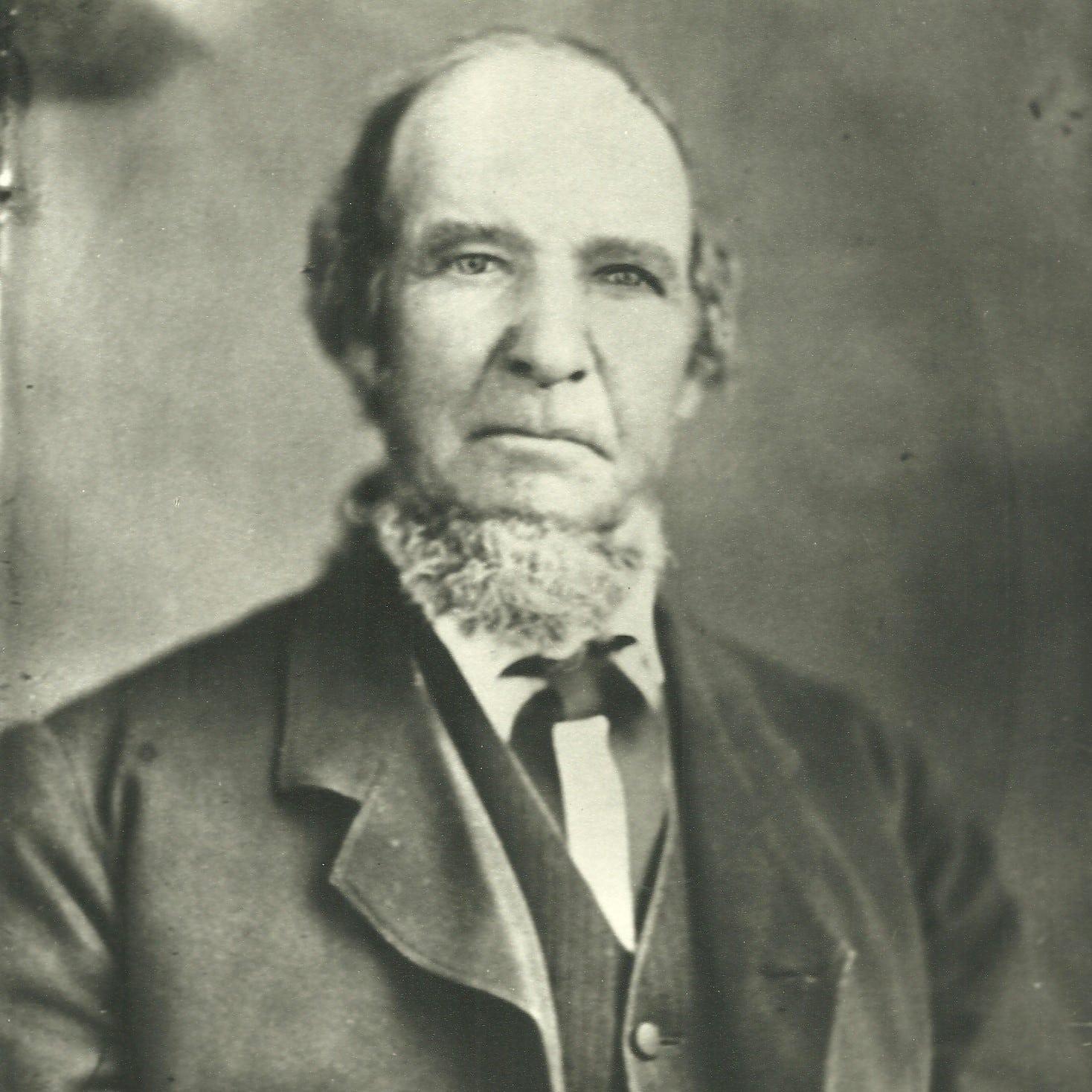
William Carter: Pioneer
William Carter was born February 12, 1821 in Ledbury, Herefordshire, England to Thomas and Sarah Parker Carter. In his youth William learned the trades of blacksmithing and glass blowing. At the age of 19 he and some members of his family were invited to a LDS meeting. William was instantly struck with the truthfulness of the Gospel. He went forward and asked for baptism. He was told that he ought to wait for a time until he could learn more.
William replied,
“If I should wait a year, I would not be any more ready than I am now.”
His mother did not feel the same way and forbade other members of the family from attending anymore meetings. William however, would not be deterred and was baptized December 27, 1840 by Elder Edward Ockey. In the end, an older married sister, Elizabeth, joined the Church with her husband. No sooner were they baptized than the spirit of the gathering took hold and they desired to go to America.
Accordingly, the crossed the Atlantic to Quebec, Canada, and then took passage through the Great Lakes to Chicago. From there they wore out their shoes walking overland to Nauvoo. They were welcomed by the Prophet Joseph Smith and William went to work on the Nauvoo Temple.
Soon after he bought a farm about two and a half miles southeast of Nauvoo and began raising grain. It wasn’t long before he met a young woman from his native land—Ellen Benbow. Their love grew and they were soon married. Not long after—June 27, 1844—Joseph and Hyrum were martyred at Carthage and their rejoicing was turned to deep sorrow.
In early 1846, when the saints began leaving Nauvoo for a new home in the West, William and Ellen went with them. When the Saints were forced into Winter Quarters on the west bank of the Missouri River, William and Ellen were there. They partook of all the misery and suffering of that place that would come to be known as the Valley Forge of Mormonism.
In the Spring of 1847 William was among those men hand-picked by President Brigham Young to be part of the first company to journey in search of their new home. On the day that they set out they journeyed some 27 miles to the west. William and some others returned to Winter Quarters. There William found Ellen very ill and not expected to live.
Alarmed, he hurried to Brother Brigham to tell him he dared not leave his wife, to which Brigham said,
“Go, brother, and I promise you that your wife will recover and drive her oxen across the plains.”
That prophecy would be fulfilled. William arrived in the Salt Lake Valley on July 22, 1847, two days before President Young. Knowing the immediacy of putting in crops, William had brought with him from the east, a plow, that he had used on a number of occasions to put in crops for those who came after. The ground however was hard and unyielding. William diverted the waters of City Creek, softened the ground, and sunk the first plow in the soil of the saint’s new Zion.
When his beloved Ellen finally joined him they settled first in the Salt Lake Valley where William worked on the Salt Lake Temple. In 1861, they were called to settle Utah’s Dixie where William once again turned his skills to building another temple.
“As foundation foreman, he led the workers in pounding great slabs of lava under the St. George Temple for strength and material impervious to a spring of water under the structure.”
Once the Temple was built, William worked for 14 years as a witness, sealer and patron receiving the saving ordinances of the Gospel for his family.
William Carter would go down in history not only as the first white man to irrigate and plow the American West, but also as the head of a noble and faithful posterity, one of whom would become an apostle of the Lord Jesus Christ—Jeffrey R. Holland.
Sources:
https://www.familysearch.org/tree/person/memories/KWJ9-S5W










Reviews
There are no reviews yet.