Description
To Sell Our Lives
Steven M. Parkin:
Friendly non-Mormons sometimes defended the Latter-day Saints. One was Peter H. Burnett. On a cold day in the winter of 1839, Peter Burnett offered his life, if necessary, to protect the Prophet Joseph Smith and his associates.
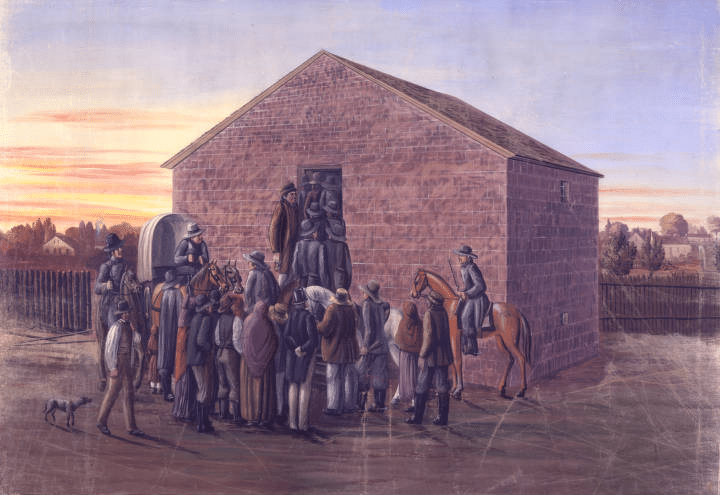
The Prophet and Sidney Rigdon and others had been arrested the previous fall at Far West, Missouri, on extreme charges, including treason, and finally dispatched to the Liberty Jail to await a circuit court hearing in the spring. However, in January, Joseph Smith and Sidney Rigdon were taken from the Liberty Jail to a court room in the nearby Clay County Courthouse for a preliminary hearing, thus securing a brief reprieve from the harsh dungeon conditions in the Liberty Jail.
Because of the cold weather, the court was held in a smaller room on the second floor of the courthouse, easier to keep warm. The smaller room accommodated under a hundred citizens who were largely incensed against the Mormons and disapproved of the hearings. Peter Burnett, a former Liberty newspaperman and young attorney assisting Alexander Doniphan, felt that their clients were in imminent peril. Both attorneys and the judge were residents of Liberty and knew well the rugged nature of their neighbors, who declared they had come to “do injury.” Indeed, Burnett feared his clients might be mobbed and the prisoners forcibly seized, and probably hung. County Judge ,Joel Turnham, known as a just and fearless man, who had the power to release the prisoners on their writ of habeas corpus, further enraged the crowd because a judge of higher rank had previously sent the prisoners to jail.
As the hearings opened, Burnett gave introductory remarks in defense of the prisoners, and the attorney general explained the charges against them. Rigdon sickly and hardly able to sit up because of his weeks in the Liberty Jail, spoke in his own defense and did remarkably well.
Doniphan then stood to give the closing remarks in defense of the Prophet Joseph. Burnett, observed the “maddened crowd” which “foamed and gnashed their teeth,” appearing wildly threatening in the close quarters of the room. Tension mounted, as Burnett slipped his hand down upon his pistol, determined, as he said, to spend his life, if necessary, to protect the life of the Prophet. He then quickly whispered to his partner, “Doniphan! Let yourself out, my good fellow; and I will kill the first man that attacks you.” Speaking of Doniphan, Peter Burnett said that his partner indeed “let himself out” in giving one of the “most eloquent speeches,” he had ever heard.
All the while Burnett sat with his hand on his pistol, to do all he had promised himself to do. Burnett remembered that he and Doniphan were willing “to sell our lives” to protect their clients.
Waiting several days, Judge Turnham cautiously freed Rigdon, releasing him at night secretly to save him from the mob. Joseph and the others were returned to the Liberty Jail, alive and unharmed, and held over for the circuit court in March.
Sources:
Peter H. Burnett, Recollections and Opinions of an Old Pioneer (New York: D. Appleton and Company, 1880), 54. In 1836, Burnett had been the publisher of The Far West, a frontier newspaper at Liberty, Clay County, Missouri.
Mark McKiernan, The Voice of One Crying in the Wilderness: Sidney Rigdon (Lawrence, Kansas: Coronado Press, 1971), 98; Burnett, Recollections, 54.
Peter H. Burnett soon went West and served on the Supreme Courts of Oregon and California, and also as California’s first territorial governor.