Description
The Science of Jesus’s Death
What I’d like to do now is going to seem a little unusual but I would like to describe in detail, from a scientific and medical point of view, what happened to the Lord Jesus in the last 24 hours of His life.
You’ll recall that while He was in the upper room, He began to feel very sorrowful and there was a heavy feeling over that room. The disciples were oppressed by it as well. And then you’ll recall that he left that upper room and went to the Garden of Gethsemane. The scripture records that He said to His disciples: “my soul is exceedingly sorrowful even unto death”.
Have you and I ever known that kind of sorrow? Emotional pain that weighs upon the physical body and brings it down unto death. That’s not hyperbole.
During the events of Gethsemane, Jesus sweated great drops of blood. Most of the Chrisian world thinks that that is some form of anxiety because of the cross that awaits him. No. It’s not. It’s the beginnings of the atoning sacrifice of the Lord Jesus Christ.
Somehow, and in a way incomprehensible, a great burden of agony, payment, atoning redemption (I don’t know all the words to describe it), came upon Him and came through Him. I have always believed that the atonement was not an infinite burden on him so much as it was an infinite stream of individuals through him.
He became the sacrificial lamb for all of us. All of our sins were placed upon Him. Every last one. Not just our sins, but also our weaknesses, our transgressions, all mistakes, every pain and distress. All of the human suffering came upon the Master that night in the garden. He was the only one that could bear it, but even then it caused Him to sweat great drops of blood.
Now medically, that is called hematohidrosis. It means that the capillary blood vessels that feed the sweat glands literally break down; they rupture under the strain and the blood released from those vessels mixes into the sweat glands and therefore the body sweats great drops of blood.
Now this condition is medically known and proven but for an individual to suffer just enough anguish to sweat from even one or two pores is almost life threatening, and Jesus’s anguish was so deep that He sweat from EVERY pore.
Suffering from the blood loss, Jesus’s skin now made exceedingly tender because of all that He endured the three hours in the garden, he is then arrested and taken before the sanhedrin. He walks maybe a mile or a mile and a half up to the place where the sanhedrin have met. He has not slept. He’s been up all night. He has suffered unspeakable anguish. And then before the sanhedrin, He is humiliated, embarrassed, mocked, and beaten, and they spit in His face. His already tender skin, and the loss of blood is worsened.
Then He is taken before Pilate. You will recall that 8 times, Pilate the pagan tries to release the Son of God, and the Jews will not hear of it. And finally Pilate basically says, “I will flog him” which means, he would have Jesus beaten.
Now, that was part of Roman law. It weakened the body in preparation for crucifixion. Usually when someone was flogged like that, the accused stood naked, strapped to a pole. And when they were flogged, they took a whip which consisted of several long strands of leather. Woven into the middle of the strips of leather were metal balls and bits of sheep bone. Every time that whip was stripped across the back, anywhere from the back of the head to the back of the thighs, it would shred the skin. It would tear out large chunks of flesh, dig deep into the muscles, the balls bruising, the bones shredding.
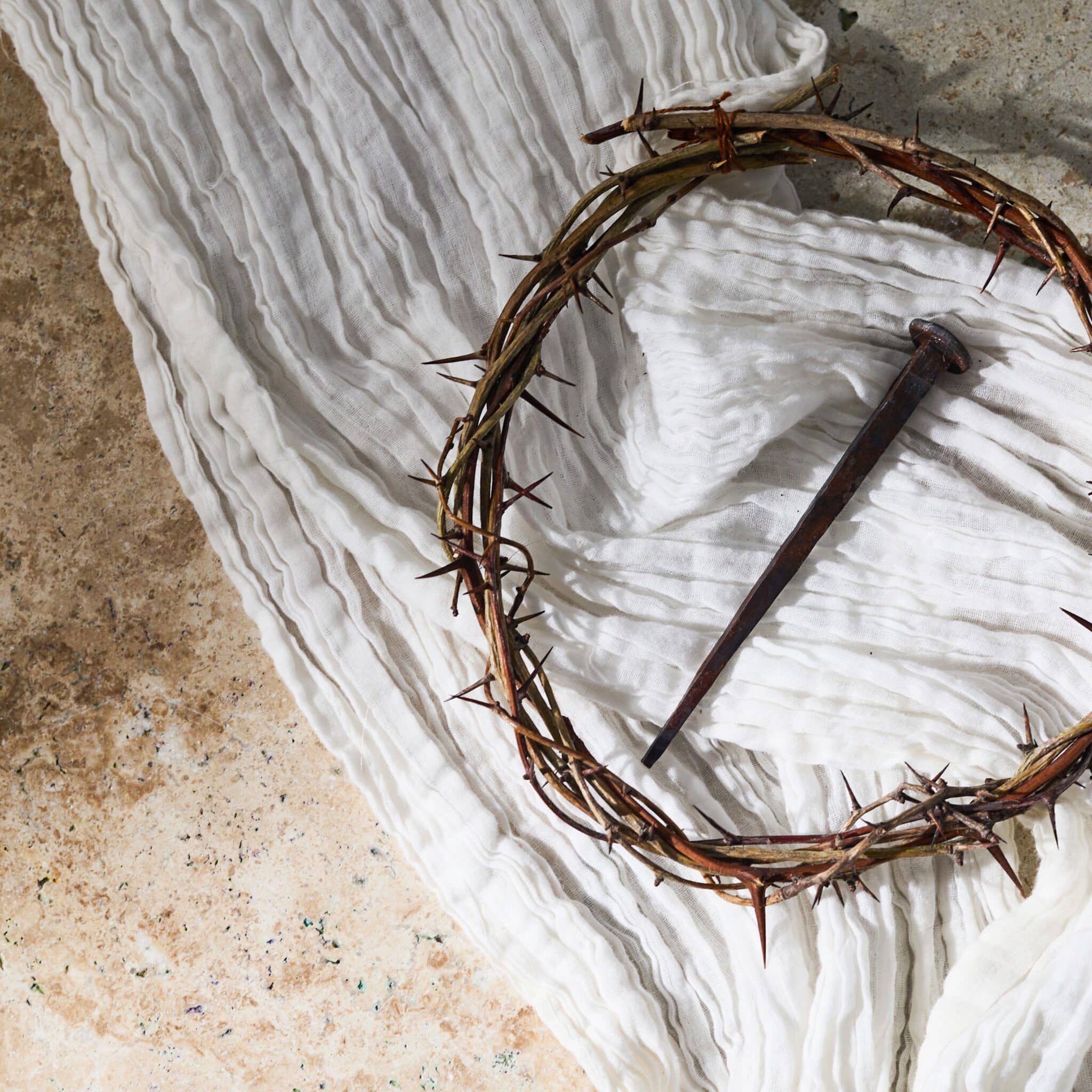
After forty stripes save one: 39 stripes, the skin on Jesus’s back would have been shredded into long ribbons. By this time, He has lost a huge volume of blood which will then cause the blood pressure to fall, and put the body into shock. And that creates all kinds of other conditions. Then the Roman soldiers plat a crown of thorns; ugly, nasty thorns, and they place it on his head. Then drive the thorns into the flesh of the scalp.
Then, they placed the purple robe that Herod had given him, against his shredded skin. It would act as a tissue against the wound and cause the blood to coagulate, clot, and momentarily stop the bleeding. Then they take the cross piece, called the patibulum, the bar that formed the T at the top of the cross. And they place that upon His shoulders and as part of the traditional punishment, He is required to carry it through the streets, outside the city of Jerusalem to the road entering into Jerusalem.
He carries it only a short distance because of His exceedingly weakened condition – He shouldn’t even be alive. So they press upon Simon, a Sirenian, and he carries the cross.
When they reach Golgotha, which translates as place of burial, they rip the robe off of Jesus’s back. And the bleeding starts again. They throw Him down to the ground and those wounds mingle blood and dirt into his flesh and there they nail him to the cross.
Now it describes that they drove the spikes into his hands and feet, but research has demonstrated that this ancient form of punishment, dreamed up by the Persians about 300 BC, involved driving a nail through the hands and/or the wrist. It was both. They could do and often did do both because the nail through the hand wouldn’t hold the weight of the body but the nail driven through the bones of the wrist would.
So they drive those spikes into Jesus’ hands and wrists and then they pick up His cross piece, the patibulum, and with Him suspended by just those nails, they lift it into the post which was already set in the ground. Then, they affix the cross piece onto the bar.
And right above it was the titleist or the place where the title was put, pronouncing this individual’s crime. In other words crucifixion was meant to be a punishment, the most excruciating that we know.
In fact, our word excruciating comes from the word crucifixion, meaning it’s an agonized death, a public form of punishment meant to set an example.
So Jesus is crucified on the road coming into Jerusalem, made a public spectacle and an example of the forsaken of God to all men.
They place him upon the cross then more than likely they put one foot over the other and drive a spike through the feet.
Imagine for a moment if you can, the pain. Just the pain alone of the nail through the hands and through the wrists. Putting a nail through the wrist severs a major nerve that runs into the hand causing spasms of pain to run up the arm and into the shoulders. Same thing into the feet, severing the nerves in the feet would cause shock and unspeakable pain through the legs. Now that’s just the beginning of it.
Jesus is already weakened from a loss of blood, from the shock of what his body has already endured. But then as you’ll recall, they come and they offer the Savior vinegar mingled with gall. No one knows exactly what that gall translates to, but it probably was sour wine mingled with myrrh. Which had the effect of being something of a drugging agent to deaden some of the pain.
This form of punishment was usually reserved for slaves and the lowest of criminals, for traitors, and revolutionaries, and the vilest of people. When Jesus received the vinegar and perceived what it was, he wouldn’t take it.
Why?
He made the full and complete choice to feel everything that was about to happen.
Why?
For that matter, why is He even there? You’ll recall that as the Savior hung there, He cried out, “My God, my God, why hast Thou forsaken me?” This is the part that the world does not understand, and neither do we. All that the devil in his machinations and power could throw at the Son of God, all of Lucifer’s vengeance, was foisted upon Jesus while nailed to the cross.
The burden and agony of the atonement was fulfilled, suffering was fulfilled, not just in Gethsemane alone but also on the cross. The emotional anguish that He felt on the cross was indescribable, literally incomprehensible to mortal and finite beings.
And the physical suffering. With the spikes driven through His hands and His body suspended in a position like that, He can’t breathe. To breathe, the diaphragm muscles pull down the lungs to fill them with air and then you exhale, forcing the diaphragm up and the lungs empty. But, on the cross Jesus can’t. In the crucifixion position, the lungs fill up with air, but can’t breathe out. The only way to respire or to breathe out is to stand up on the nails driven into the feet. That’s the only way He can breathe. He’s already suffering a horrible thirst from blood loss and the shock and the pain of all of what he’s dealing with, and now, He can’t breathe. He’s suffocating.
The nail driven through His hands seven to nine inches long severs the major nerves in His hands and in His feet, it’s called the median nerve. By standing up on the nails, He is allowed some measure of breathing but oftimes when they nailed wrists and then lifted them up like that, it dislocated the elbows and the shoulders. As Jesus hangs upon the cross, unable to breathe, there begins to be a build up of carbon dioxide in the blood, the heart starts beating faster to compensate for the lack of air, and because of the buildup of carbon dioxide, the capillaries begin to break down. There starts to be a build up of fluid in the lungs and the area around the heart, called the pericardium. And the longer He hangs there, the more difficult it becomes to breathe. As the fluid builds up, the lungs begin to collapse. Sometimes the stress of it was so bad that the individual at that point would just simply die of a heart attack, cardiac arrest, the heart would just stop.
In other cases though, this seems most likely, the accelerated stress on the heart and the build up of fluid around it would lead to what is called cardiac rupture. The left ventricle, the bottom part of the heart, simply; that which expelled the blood throughout the body, burst. And there He hung from 9 in the morning until 3 in the afternoon.
Indescribable pain; physically, emotionally, spiritually.
At the end, He says “I thirst”. Now we know why He thirsted. The loss of blood creates a raging thirst. They gave Him something to drink and when He had received it, He said “Father, it is finished, into thy hands I commend my spirit.” and then, voluntarily, He died.
Now, the sabbath was coming on, and it was against Jewish law to have these crucified victims handing on the cross. They didn’t want them to violate their sabbath so they would appeal to the Romans and Pilate dispatched soldiers who came.
Do you recall what they did? They went to each of the thieves crucified with Jesus, one on each side, and with a big club and a mighty swing, they broke their legs, probably hit them right across the shins. That would effectively cause both of the thieves to suffocate quickly as now they are unable to stand up and breathe.
When they came to Jesus they discovered that he was already dead. And for whatever reason, to assure that he was dead, one of the soldiers reared back and thrust a spear into his side. John records that “forthwith came thereout blood and water”. What was that? Blood, may well have been the blood from the ruptured heart and the water or what appeared to be water, the fluid that had built up around the heart. I’m not a doctor, so I don’t know all of the technical terms, but medically, it makes sense what they did to murder the Christ.
Now, why was the Savior even there? He didn’t have to be there, He’d told Peter earlier “thinkest thou not that I can call upon my Father and He will presently give me more than 12 legions of angels?” I think 72,000 angels sent from the courts of glory could have taken on the entire roman empire, let alone deal with a centurion, a few soldiers, and some jews. He didn’t have to be there. He went voluntarily and He suffered every measure of pain in its fullness willingly.
Why?
You . Me.
He died for us.
In the most painful way imaginable, He died for me. He died for you. Sacrificed his own life because of His love for you and the Father’s love for us. He took the sins in us into His body on the tree, Peter said. I was, in effect, nailed up there with Him.
The next time you’re taking the sacrament, remember Jesus’s suffering. Remember His pain, remember what He did in His body on the tree.
Sources:
Davis, C. Truman. “The Crucifixion of Jesus.” Arizona Medicine, 22, no. 3 (1965): 183-187.
Edwards, William D., et. Al. “On the Physical Death of Jesus Christ.” The Journal of the American Medical Association 255, no.11 (1986): 1455-1463.
Matthew 27:33-56, Mark 15:22-41, Luke 23:27-49, John 19:17-37
Matthew 27:26-32, Mark 15:15-21, Luke 23:25-26, John 19:1-28
Matthew 26:67-75, Mark 14:61-72, Luke 22:54-23:25, John 18:16-27
Matthew 26:36-46, Mark 14:37-42, Luke 22:39-44
The Science of the Crucifixion MARCH 01, 2002 | WRITTEN BY CAHLEEN SHRIER, PH.D. | ADAPTED TALLY (FRENCH ’00) FLINT