Description
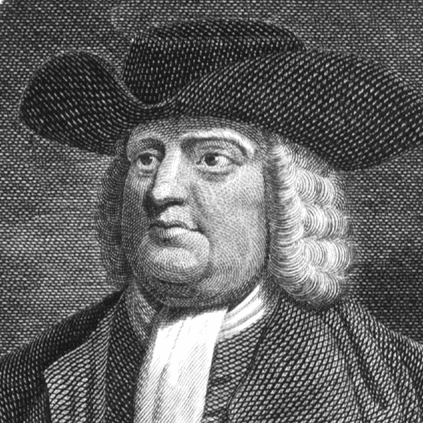
The Holy Experiment: The Story of William Penn
William was born on Tower Hill in London, England, the son of a prominent and wealthy English naval man in 1644.
In 1659, because of the English Civil War, the family was exiled to Ireland. It was here that William’s father invited Thomas Loe, an itinerant preacher, into their home. When Loe preached that all men are born with an inner light that connects them to God and to which they must answer only to Him, William believed him. He would later say, ”The Lord visited me and gave me divine Impressions of Himself.”
In 1660, the family returned to England and William’s father played a significant role in restoring the monarchy in England. In 1666, William was sent to Christchurch college in Oxford. To the dismay of his father, William became involved in protests against the established Church of England. It was his firm belief that governments had no right to dictate forms of worship and control conscience. For this he was expelled. His father was furious.
Notwithstanding his social standing and prominent family, William rejected it all for conscience. In 1668, he joined a radical, heretical, religious movement, and was jailed for blasphemy. Six times he would be sent to prison for teaching that governments had no right to dictate forms of worship or control conscience, at least one of those imprisonments would be at the Tower of London, near where he was born. He once wrote, “My prison shall be my grave before I will budge a jot: for I owe my conscience to no mortal man.”
His stance on conscience cost him his social standing, his good name, and even his family. His father banished him.
By 1672, William was again in Newgate Prison in London, and his father was dying. Both wanted to make things right and so, notwithstanding William’s protests, his father purchased his freedom. By now, his father had gained respect for William’s principles, telling him, “Let nothing in this world tempt you to wrong your conscience.”
As a final act of kindness to his son, William’s father wrote to the future King of England asking for his son to be protected by the Crown. The request was granted.
William’s father passed away and William was now a wealthy man. Nevertheless, he continued his labors for religious tolerance and freedom. Across Europe his people were being persecuted and killed.
William came up with a novel plan—a mass migration of religious dissidents to America. When the idea was presented to King Charles II, he liked it and in 1681, a generous grant of land in America was given to William.
In 1682, William landed on the west bank of the Delaware River. Unlike many who would follow, he fairly purchased the land from the natives and set out to design a city and a colony unlike any other in America. He would call it his “Holy Experiment,” because all men, of any race or religion, would be welcome and they would be free to govern themselves according as their conscience moved them.
William planned a beautiful city, open, green, and healthy and named it Philadelphia or “The City of Brotherly Love.” His colony would become the largest and most prosperous melting pot of humanity in the new world. William wanted to call it “New Wales,” but the King insisted that it be named for William—and thus it came to be called “Pennsylvania” or Penn’s Woods. The dissident son who gave all for the cause of Christ was William Penn. Today his statue stands high atop city hall watching over his city.
What was William’s holy experiment? That all men are created equal and capable of governing themselves. It is no accident that the United States of America—what would later be called “The Grand Experiment” was born in Philadelphia, Pennsylvania. William was right.
Sources: https://en.wikipedia.org/wiki/William_Penn
https://www.pennsburymanor.org/the-manor/william-penn-timeline/