
Description
Speaker: Glenn Rawson
Hi, this is Glenn Rawson. One of the most powerful ways to share history and heritage is by the telling of stories. We began sharing inspiring stories nearly 30 years ago. Each of those stories is true and was intended to inspire and strengthen faith. Over the years, those stories have reached millions around the world. This podcast is for you to listen, learn and enjoy.
First Story:
This story happens all along the pioneer trail, but I think you’ll see that where it culminates is very significant.
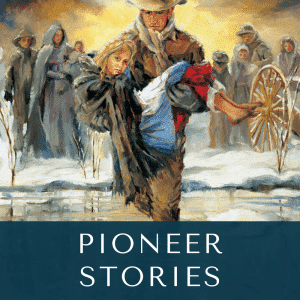
David Blair was a member of the Martin Handcart Company and a most unusual one at that. He was born May 5, 1810, in Ayrshire, Scotland. He married Deborah Jane Bushnell at Buckingham, England in 1841.
According to the accounts in the journals, he served for a time in London as one of the royal lifeguards of Queen Victoria. I don’t know, maybe someone does but by 1856 he had become a member of The Church of Jesus Christ of Latter-Day Saints and was attending the London branch. And in 1856 when members of the London branch emigrated to Zion, David Blair and Deborah and their family were on the ship ‘Horizon’ and set sail with the rest. They came to Iowa City. They were part of the Martin Handcart Company.
Now, in describing Brother Blair, one of the boys in the London branch said this (Albert Jones) he said quote, “A Brother Blair, one of the royal lifeguards, blue of her majesty, the British Queen was with us, whose grand physique and gigantic frame was the admiration of all of us boys in the London branch whenever he attended meeting in his regimentals”, end of quote.
You just picture that – tall, big, strong, handsome man in this royal lifeguard uniform coming to church and all the boys in the branch are going, “wow that’s cool.”
And now here he is, out on the high plains of Wyoming. Patience Loader, also remembered him on the trail and she said this of him, quote:
“I remember well, Brother David Blair. He was a fine, tall man, had been one of Queen Victoria’s lifeguards in London”, so she also remembered him.
As the difficulties deepened for the Martin Company and all began to suffer, David Blair stepped forward as so many other men did. Patience described she said, quote: “He had a wife and small children. He made a cover for his handcart and put his children on the cart. He pulled his cart alone. His wife helped by pushing behind the cart.”
“Poor man”, Patience wrote, “He was so weak and worn down that he fell down several times that day but still he kept his dear little children on the cart all day. This poor man had so much love, Patience said, for his wife and children that instead of eating his morsel of food himself, he would give it to his children”.
Brother Blair was not the only one to do this, that’s why in the Martin and Willie companies so many of the grown men died. Brother Blair poured out his life in service to his family and to others.
Finally, just west of Martin’s Cove, don’t know exactly where, Brother Blair succumbed and lay dying. His wife ran through the camp crying aloud for someone to help her. Ephraim K. Hanks was there. He heard her and he followed her to inquire the matter. She went to Brother Daniel Tyler and asked him to come with her and administer to her husband, but Brother Tyler saw the lifeless form of her husband. He was dead.
On seeing him, Elder Tyler remarked, “I cannot administer to a dead man.” Brother Tyler then requested Eph to stay there and lay out the dead brother and prepare him for burial while he went back to his wagon just to get some rest that he so sorely needed.
Eph then said, “I immediately stepped back to the campfire where several of the brethren were sitting and addressing myself to Elders Grant Kimball and one or two others. I said, “Will you boys do just as I tell you?” The answer was in the affirmative. We then went to work and built a fire near the tent which I and Elder Tyler had just visited. Next, we warmed some water and washed the dying man whose name was David Blair from head to foot. I then anointed him with consecrated oil over the whole of his body. After which we laid hands on him and commanded him in the name of Jesus Christ to breathe and live.
“The effect was instantaneous”, Eph wrote. “The man who was dead to all appearances immediately began to breathe and set up in his bed and commenced to sing a hymn”, Eph concluded. His wife, unable to control her feelings and joy and thankfulness, ran through the camp exclaiming, “My husband was dead but is now alive! Praise be the name of God! The man who brought the buffalo meat had healed him”.
I wish the story ended there. It doesn’t. From the journal record, it appears that Brother Blair was indeed healed and continued on to labor in bringing his family to safety and he almost made it.
Patience Loader concluded, “Poor man, he pulled the cart as long as he could and then he died, and his poor wife and children had to do the best they could without him to help them. The poor children got frozen. Some parts of their bodies were all sores, but they all got into Salt Lake City alive but suffering”, end of quote.
Brother Blair had come some six thousand miles on his journey to Zion and passed away at Quaking Aspen Grove, just 16 miles outside of Salt Lake City. He almost made it. But did he make it to Zion? Yes. Like you, the moment he entered into those covenants that he would serve God and journey to the promised land, he was already there – true and faithful to the very end.
Second Story:
I’m going to share something else that a friend of mine shared with me. She said it probably better than I’ll ever be able to say it. If I can just fast forward my notes here and get down to that.
One of those that was traveling with me was Jean Tonioli and her niece Karen Poach. The two of them became and have been good friends. I had a sweet experience with both of them as we traveled from Casper, Wyoming back into Salt Lake. If you don’t know that tour, as we said, we go from Casper all the way down to Martin’s Cove and then from Martin’s Cove to the 6th Crossing of the Sweetwater and from there, the next day, we travel down to such places as South Pass and then from there, down to parting of the waves and Farsen, Simpson’s Hollow. In fact, the last stop on our trail is where the trail crosses the Green River and that’s where I want to tell you the following story. I’m gonna quote Jean’s letter as she sent it to me. I got it just this morning she said, quote:
“I just spent three days on a bus tour from Salt Lake City, Utah to Casper, Wyoming and then back to Salt Lake. The purpose of the trip was to follow the Pioneer Trail and learn stories of the people who made the arduous journey from Nebraska to Salt Lake City. And then she said, “…so why would anyone spend three days in August driving across the barren landscape of Wyoming?”
I love that, and then Jean continued. “For me, it was a personal journey of discovery, she said. I have several families, a several family members she said, who walked the Mormon Pioneer Trail. The spirit of gathering with the Saints was burning in their souls. They would get to Salt Lake or die”, she said.
“So, this week I stood, she said on the Pioneer Trail where they had walked. I saw hundreds of miles of bleak sagebrush and the monotony of never-ending miles they trudged. The landscape broken up only by hills and mountains which made the trek infinitely harder. I experienced, Jean said, a little of the rain, hail, wind and sun which was part of their everyday journey. This was a barren wasteland in comparison to Sweden, Denmark and England and yet they willingly followed the trail. The spirit of place came over me, Jean said, and I had a new connection with those names on the family tree. I was sharing a part of their history which couldn’t be gained from the words I had read in a journal.”
And this is the point my friends, why I share this with you.
Jean said, “I have a new appreciation for the challenges which came from the rivers they needed to cross. If I get in water over my head in a river, there’s a very good chance that I can make it to the riverbank on the other side. However, I wouldn’t be wearing a long, woolen skirt or trying to keep the babies and little ones I was caring for afloat. River crossings, she wrote, were dangerous and many people drowned or fell through the ice that wasn’t sufficiently frozen to walk on. Because of being there and hearing stories of the challenges the pioneers faced, I have a new respect for river crossings and the bridges that I have taken for granted. The banks of the Green River at Lombard Ferry will always be a sacred place because this river was the nemesis of some of my ancestors.”
“William Clayton recorded that the river was about 300 feet across and altogether too deep to be formed. She’s right! A ferry was established to help the immigrants across. She said my great-great-grandparents William and Rachel Atkins and their two small children were members of the William George Rowley Handcart Company and because of distributing excess food rations during the first weeks of the trek, the company, the Rolly Company was starving. A couple of days’ journeys before the company were to cross the Green River some men asked the camp if anyone knew how to butcher animals.”
Well Jean wrote her grandfather William did and he stayed behind to do the job with the promise that he and his family would be given food. The company went on and he and his family continued the journey along planning to meet up with them before the river. However, when they reached the Green River, they found that the company had already crossed and moved on and there was no ferry available and no one to help them across.
Jean wrote, “…after praying to the Lord, they put their two little children in the handcart and started to cross expecting to sink under the water with each step, they miraculously made it across without even the axle tree of their cart getting wet.”
“This location, Jean said, was the place of a miracle. The spirit of place helped me understand and share a little of the challenges my family members faced. This place will always be sacred ground to me. And then she continued, “On this same spot of the Green River, I paid silent tribute to my great grandfather Swen O. Nielsen’s brother, Peter.
Do you remember me telling you the story of the boys of the San Pete? Well, about a group of boys that were bound for Missouri going back to rescue or bring out to Salt Lake immigrants as part of the down and back wagon system that this group of boys from the San Pete got to the Green River and suffered disaster and six of them died as missionary martyrs trying to bring immigrants home safely? Well, among those six, and I didn’t know this, was Jean and Karen’s great uncle, Peter Nielsen. He was 20 years old when he and the others drowned there at the Green River trying to get across the other side so that they could rescue the immigrants.
Jean said, “Again, the spirit of place helped me share the sadness and loss of my family”. And then again Jean said, “The tour ended at (this is the place) Heritage Park at the Pioneer Children’s Memorial. At the monument to children who were lost on the Pioneer Trail, this is a sacred place for our family”, she wrote. “My great, great grandmother Pernilla, Neil’s daughter Baum, immigrated in 1863 from Sweden with her three young children – ages 9, 6 and 4. Her husband and older son would come two years later when enough money was saved. Pernilla and her children entered America at Castle Garden and were transported in box cars to Florence, Nebraska. They joined a wagon train of immigrants headed for Utah and they walked.”
Swen O. Nielsen wrote this: “Sena, age four the only sister I ever saw was ill from the time she left Florence. After two weeks of travel, she died. As we were not provided with lumber, the only thing we could do was to wrap her little body in a sheet and bury her on the lonesome plains.
This was early in the morning, the train moved on. After gathering some wildflowers from the hillside, we decorated her grave and left her resting on the plain, numbered, numbered with the unknown graves.
Now Jean concludes, “There was no grave marker or place to go to remember the little girl until the children’s monument, the Pioneer Children’s Memorial was built, and this is the Place Park. At the very top of one of the markers, it lists this name Sena Kareem Nielsen, age four, standing right next to that statue or right next to that marker are statues of children and right next to the marker what lists Sena’s name there is a pioneer boy about nine years of age the same age that Swen was when he buried his little sister, and he stands there looking over that stone.”
Jean concluded with this, “I like to think that he was put there that statue, he was put there to represent big brother Swen who had to leave his only sister in an unmarked grave on the plains and that now he is guarding his sister and her memory.
Jean said, “The people on the pages of my family history are not just names but real people who lived and are now a part of my history. The spirit of the gathering brought them design and their testimonies of faith to this day influenced their posterity. The spirit of place added a dimension to my understanding that could not come any other way and inspire me to face my own challenges”, end of quote.
Julie B. Beck, former first counselor in the Young Women General Presidency, former Relief Society president said this, quote:
“Until the history of who you are is in your hearts, you won’t be as strong as you could be”.
My dear friends, I invite you to turn your hearts to your fathers and your mothers. Search out their history. Come to know them and if you can, send you and your posterity to the places where they made history. If you can. You don’t have to but if you can, it’s worth doing it. My dear brothers and sisters, God bless…
Thank you for listening. Many of the stories you heard today have been published and are archived at glennrawsonstories.com. If you would like more information you can communicate with us there. We will be back again with another podcast next week.








Reviews
There are no reviews yet.