Description
She Would Have Met Her Death
The date was Sunday November 9, 1856, the place—Martin’s Cove, Wyoming. It was on this date that the awful winter weather abated somewhat and the emigrants of the Martin Handcart Company began the last of their journey to Salt Lake City, many of them riding in wagons provided by the Hunt and Hodgett wagon trains.
The emigrants were so weak and sickly that most had not the strength to walk. Their handcarts were abandoned and as many as possible were loaded in the wagons.
On this morning, the wagons rolled out—bound for Salt Lake City, 300 miles away. Josiah Rogerson was there, one of the last to leave, and relates the following:
“One of the young ladies whose mind became affected by the fatal crossing (meaning the last crossing of the Platte river) had left her own campfire immediately after the last relief wagon had rolled out from here in the snow on the morning of Sunday, Nov. 9, apparently in search of some scraps of food or meat, and had got to a fire round a point in the rocks, near to where my brother and I were roasting some pieces of meat and rawhide for lunch.
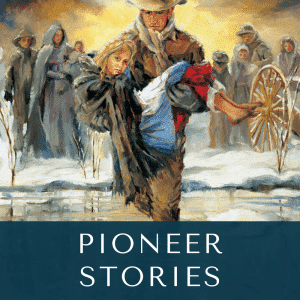
“As we arose to go and catch the wagons (divest now of our carts), we caught sight of the young woman sitting at the fire and staring at us with dazed eyes. We tried to rouse her from her lethargy, but she was all childish indifference. Sending my brother ahead to stop the last wagon, he returned, and making a chair of our arms, we carried her a rod or two at a time for a couple of hundred yards, as she was not able to walk, and the teamster coming to our relief, she soon was placed in his wagon.
“In the early part of our journey, she ranked as one of the most beautiful in face, tall and well formed, in the company, and had we not discovered her when we did, the chances are that in less than an hour she would have met her death—as Father Stone did—a feast for the mountain wolves. She was then about 20 years of age. Succeeding in reaching Utah with us, she recovered her mind by kind nursing that winter, and in the spring or summer following married one of the most prominent and well-to-do first settlers of Ogden city. (Rogerson, Josiah, “Martin’s Handcart Company, 1856 [No. 8],” Salt Lake Herald, 24 Nov. 1907. Available on Mormon Pioneer Overland Travel website.)
That young woman was Mary Horrocks, and a convert from England, traveling with her sister Elizabeth Horrocks Jackson. Indeed, Mary went on to the Valley, settled in Ogden and married a prospering attorney named Nathaniel Leavitt. Together they had twelve children. Who can number their descendants now?
What if that cold winter day, Josiah and his brother had weighted their own needs greater than hers and just left her there? How would so many lives today be different?
Sources:
Rogerson, Josiah, “Martin’s Handcart Company, 1856 [No. 8],” Salt Lake Herald, 24 Nov. 1907. Available on Mormon Pioneer Overland Travel website
1Josiah Rogerson had previously written of Oct. 19: “The results of wading of this river by the female members of our company was immediately followed by partial and temporary dementia, from which several did not recover till the next spring.” (Cite Herald series reference)
2Mary Horrocks turned 20 years old in September 1856. Her family history states that after the October 19 Platte River crossing, “she was so sick that she became deranged in her mind, and for several days she ate nothing but hard frozen snow.” Mary and her sister, Elizabeth Horrocks Jackson, whose husband Aaron died the day after crossing the Platte River on October 19, both went to Ogden to Samuel Horrocks’ home. Samuel was their brother who was already in the valley. Elizabeth and Mary both lived in Ogden the rest of their lives. Mary married Nathaniel Leavitt, Jr., of Ogden, Utah, on April 4, 1857. His biography indicates he was an “extremely prosperous” and prominent man in Ogden.
One other indication that Mary Horrocks was the young woman almost left behind at Martin’s Cove, is the similarity of this account, written by her sister, Elizabeth Horrocks Jackson, regarding Mary’s behavior one night after the last Platte River crossing: “A few days after the death of my husband, the male members of the company had become reduced in number by death; and those who remained were so weak and emaciated by sickness, that on reaching the camping place at night, there were not sufficient men with strength enough to raise the poles and pitch the tents. . . . My sick sister, the first part of the night, climbed up hill to the place where some men had built a fire. She remained there until the people made down their beds and retired, to sleep, if they could. She then climbed or slid down the hill on the snow, to where there was another fire which was kept alive by some persons who were watching the body of a man who had died that night. There she remained until daylight.” (Leaves from the Life of Elizabeth Horrocks Jackson Kingsford, December, 1908, Ogden, Utah)
https://www.familysearch.org/en/tree/person/memories/KWN4-SV8
Glenn Rawson November 9, 2024