Description
She has Been Here: Ma Manuhii
Years ago, there was a moment here in Laie, Hawaii, when President Gordon B. Hinckley and the president of the Laie Temple, D. Arthur Haycock, stood and looked over a hill just above the temple. The hill was covered with jungle growth and had become a dumping ground for junk.
The two men stood and looked over it. “This ought to be cleaned up,” President Haycock said, and President Hinckley responded “You’re the Temple president.” To which Elder Haycock said “I know, but that isn’t my duty.” To which President Hinckley responded “It isn’t your duty, but you know you want to do it.”
With that President Haycock went to work, secured help from Herbert Norita and others. Contributions were made and all the garbage was removed—tons of it. When it was all done, they had discovered, buried beneath, an old Hawaiian burial ground. They cleaned up and replaced the headstones, built walkways, beautified the area, even building a driveway and a beautiful fale or pavilion.
It was transformed from a garbage dump into a quiet place of meditation. President Hinckley said, “I have thought many times that ought to be called the Haycock sanctuary.”
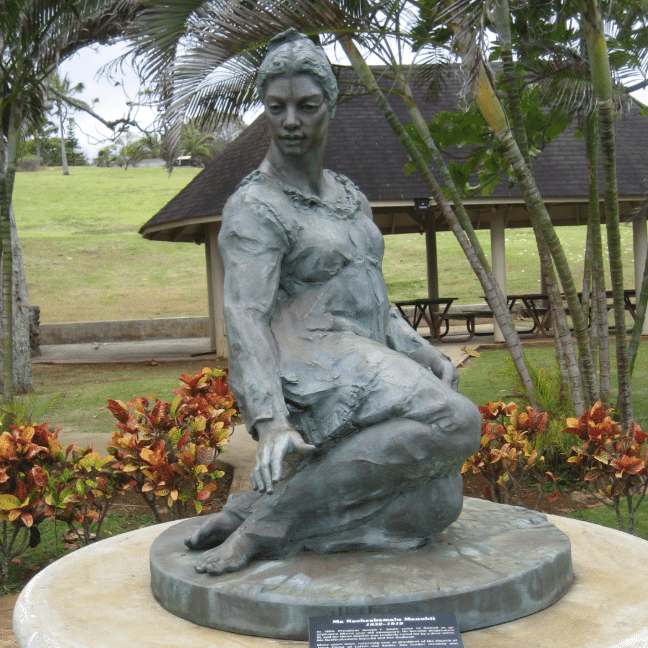
Perhaps the finishing touch was that President Haycock wanted to place a statue at the entrance to the burial ground to celebrate the life of one of the more prominent people buried there. Here is the story.
When Joseph F. Smith was called on a mission to Hawaii at the tender age of 15, he began his laborers in Maui and on the big island. Then he was transferred to serve on Molokai, where he became a presiding Elder. He was only 16. While serving there, the young Elder Smith was taken with a fever and became very very sick. Here he was, an orphan boy thousands of miles from home—helpless and critical.
It was at that time that he was taken in by a native brother and his wife. The woman’s name was Sister Ma Manuhii. Over the next three months, she cared for him and nursed him back to health. It goes without saying that the bond between them became very strong.
Years later, when Joseph F. Smith returned to the islands, now the President of the Church, he was met at the docks by
“a poor old blind woman tottering under the weight of about 90 years and being led in. She had a few choice bananas in her hand. It was her all—her offering. She was calling ‘Iosepa, Iosepa.’ Instantly, when President Smith saw her, he ran to her and clasped her in his arms, hugged her and kissed her over and over again, patting her on the head saying ‘Mama, Mama, my dear old Mama,’ and with tears streaming down his cheeks, he turned to me (Bishop Charles Nibley) and said ‘Charlie, she nursed me when I was a boy sick and without anyone to care for me, she took me in and was a mother to me.”
It was that same Sister Ma Manuhii who was buried on that long-forgotten Hawaiian hillside. It was the desire of President Haycock to remember her. He commissioned Brother Jan Fisher of the BYU Hawaii art faculty to create a statue of Ma Manuhii.
Brother Fisher went to the temple, where he fasted and prayed on how to proceed with this sacred commission. “It was then that he felt an impression to go out to a remote jungle area to the site of an ancient altar.” There he knelt before that jungle altar and was blessed with a remarkable vision.
“The veil was parted and a young and lovely Ma Manuhii stood before him. As the vision continued, Ma Manuhii knelt and gently lifted the sick and suffering boy, Joseph F Smith and carried him in her arms to her little hut. She then placed Elder Smith on a mat and nursed him tenderly.”
Brother Fisher was able to see in exquisite detail her beautiful hands and feet and lovely brown face. At the close of the vision, Brother Fisher, with tears streaming down his face, “knew with a surety that death is not the end and that our loving Heavenly Father answers prayers, sometimes in miraculous ways.”
He returned to his studio and began to create the image of Ma Manuhii based on the vision he had seen. He finished the piece in a record 24 hours.
When Brother Fisher finished the beautiful statue of this lovely and charitable Hawaiian woman, it was shown to President D. Arthur Haycock, who turned to Brother Fisher and commented, “she has been here hasn’t she, Brother Fisher?” He responded. “Yes, she has President. Yes, she has.”
It was a testimony to Brother Fisher and a story for all of us that death is not the end. We live on and our connections to this earth go on forever. And also, a witness that the smallest acts of godly kindness are never forgotten.
Source:
Gary Fisher, son of Jan Fisher