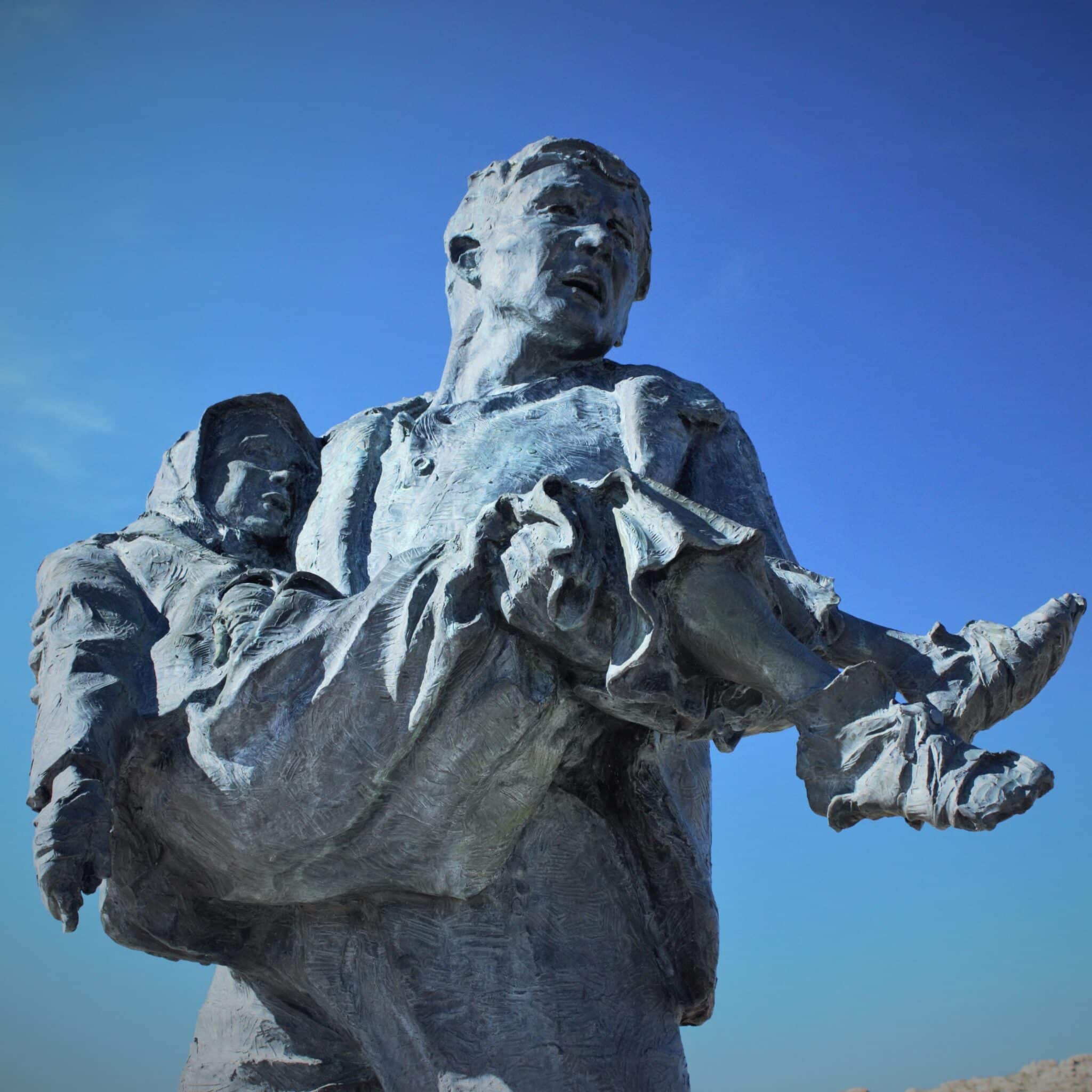
Description
Never, Never, Never, Give Up!
It was a most unusual mission, but a mission indeed, it was when President Brigham Young called upon the Saints beginning on October 5, 1856, with fervor and power to man up and bring in those Saints of the Martin and Willie handcart companies, yet upon the plains.
Dozens and dozens of men from all over the Territory turned out and started to the east. The first and most heroic of those rescue teams was led by George D. Grant. They pushed on into Wyoming nearly 350 miles, finding all those companies late in coming.
Captain Grant and his men brought the combined companies as far as Martin’s Cove, Wyoming where a series of deadly storms forced them to shelter against the granite cliffs of the mountains. For five days they hunkered down and awaited relief from the storms, and more rescuers with laden wagons of supplies… but those wagons did not come!
It was November 10, 1856, when Ephraim Hanks met the emigrants of the Martin Company near Ice Springs Bench in Wyoming, bringing word as recorded by William Broomhead:
“[Ephraim] Hanks came to us from the valley and reported that 2 hundred teem had started but he did not [know] if they had not turned Back on account of the storm and that [some] came [or “came up”] to our post and scared out and turned back.”
Daniel W. Jones reported it this way:
“There was much suffering, deaths occurring often. Eph Hanks arrived in camp from the valley and brought word that some of the teams that had reached South Pass and should have met us here, had turned back towards home and tried to persuade Redick Allred, who was left there with a load of flour, to go back with them. The men who did this might have felt justified; they said it was no use going farther, that we had doubtless all perished. I will not mention their names for it was always looked upon by the company as cowardly in the extreme.”
Two men had indeed left Redick Allred and their post on South Pass. They could not persuade Redick to go back with them, so they left him and started for home on their own. Had they pushed on bringing the food they carried, lives would not have been lost and extreme suffering would have been mitigated.
Those two men abandoned their post and started for home, turning back every other team with them, with the exception of Anson Call and his wagons—they went on. According to accounts, 77 teams of rescuers were persuaded to give up and turn back. John Pulsipher wrote of them:
“Those men said the reason they turned back was because they could hear nothing from the last handcart co & supposed they had gone back to the States or made their winter quarters in the Buffalo country. But they were very much blamed for letting the devil put any such thoughts into their heads – when the word of the Lord comes for men to do anything they ought not to turn back for a little snow, or fear of losing their horses or any other foolish notion – If to do anything except he gives them strength to do it if they are faithful.”
When word reached President Brigham Young that the teams had turned around, he dispatched an envoy of men to meet them and turn them eastbound again—as William Kimball is reported to have said, “that he did not care if he turned some so quick that it would snap their neck”.
And the teams were turned around and went to meet the Martin Company. Hosea Stout reports the condition of the Martin Company when the teams met them near South Pass:
“This presented a sad sight to see men, women & children thinly clad, poor, and worn out with hunger & fatigue, trudging along in this dreary country, facing a severe snow storm and the wind blowing hard in their face. The wagons could not accommodate the half of those not able to walk. Many were sick and many frosted and some severely….The snow storm increased all evening but the tents were reared and the poor sick saints had many of them to be carried in.”
And the Martin Company was thus brought on into the Salt Lake Valley, but those two men who quit their mission and went back…
Each time I consider the implications of all those who quit—the lives lost, and the suffering unrelieved—it fills me with a sense of horror. Oh, that they had acted differently and not tendered so many excuses. They were so close and they gave up—and the Martin Company paid for it.
May it be that we learn from them, and if we are ever called to any sort of mission of rescue, let us be faithful-never, never, never give up!
Sources:
Jolene Allphin’s Rescue Timeline in possession of author.
Joel Hills Johnson diary for May 6-7, 1857, places him in this area (traveling eastward) where the Martin company was on Nov. 10-11, 1856: “Wednesday 6th. We started the usual time and crossed the Sweetwater three times, and turned out our teams for noon. In the afternoon we passed by a grave where there had been several persons buried belonging to one of the hand cart companies. The wolves had dug up and devoured them as their grave clothes and pieces of their bones were scattered around the grave. We camped for the night on the river. Thursday 7th. Started at 8 o’clock and arrived at Devil’s Gate about noon, and concluded to stop . . . The south wind blew almost a hurricane through the day.
Copyright Glenn Rawson