Description
I Will Set on You a Refiner’s Fire
Inside this story is hidden an answer to this question: “Why does the Lord not hear and answer my earnest prayer—now?”
John was born in Simpson County Kentucky in 1808. He said:
“From my first remembrance I had serious reflections on futurity. My parents being of Methodist faith, and hearing them talk about it, I had impressions on my mind that I shall never forget.”
From the age of 7 until his early 20s, John was sorely afflicted with what he called attacks of “rheumatics,” that caused him to suffer terribly and nearly cripple him. In one of those last episodes. John said:
“I began to have serious reflections at times about my future existence and I often thought what the Lord wanted of such a being as me upon the earth and I desired either to have my health restored and become like other boys at my age or die, for I did not like to live in that way.”
And then came a period of remarkable growth. Notwithstanding his afflictions, John grew to be six feet tall. Around the same time there was a period of revivalism. He went to some of the meetings and while his companions rejoiced and “professed a remission of their sins”, John could feel nothing, and he refused to pretend. “I made up my mind,” he said, “if there was such a thing as religion, I would have it and keep it as my own property letting no one know it.”
One day while in Church, he said:
“I thought I could see every sin I ever committed and while in this condition I felt as though my seat was sinking from under me all at once. Thus, I felt with all my soul to call upon the Lord God to forgive me, a sinner, and all of an instant, the burden left me and I felt to rejoice for a minute or two.”
A voice said to him, “You have yet to preach the Gospel to the world.”
From that point forward, John poured out his heart in searching the scriptures. From them, and from all the strife and contention around him, he was persuaded firmly that the true Church was not in his part of Kentucky. It was all, he said, “A mess of confusion.” Nevertheless, John continued attending his Church and praying with all of his heart for the truth—doing the best he could.
Finally, in 1832, John had had enough. He said:
“A rebellious spirit took hold of me, and I made up my mind that I would stop going to meeting for it was all contention and nothing to be depended upon and if I read the Word of God I could not comprehend it, and when I prayed I could get no answer, and finally I concluded that I would be as independent as God himself. If he would not answer me when I pray, I would quit praying to Him, and as he would not give me an understanding of the Scriptures I would quit searching them and lay all aside.”
In that angry frame of mind, John walked out into his orchard and discovered that the wind had knocked down several of his fruit trees and damaged others. This made him feel even more frustrated at God. Lightning flashed overhead, to which John responded:
“I know you can strike me dead with lightning but pop away if you wish for I will neither preach, pray, go to meeting, nor read the Scripture anymore.”
A moment or two later, John was in the act of feeding his horse when a voice spoke to him saying:
“‘I will set on you a refiner’s fire.’ I turned about to see who it was that spoke to me, but I saw no person. I then looked round the barn but saw no person. I certainly thought that someone spoke to me for the voice was so audible, but yet, I still heard no one, neither saw I anyone. This set me to thinking of what I had been doing. I had been defying God.”
John determined that he would pray just one more time and give it all he had.
“I started,” he said, “to a place in the field where I often went to pray. I got about fifty steps from the house. My whole mental powers seemed to be drawn out to God to know the truth, and the true order of His Kingdom, and if I could only know what, I would do anything even to the laying down of my life, if necessary. While in the exercise of mind there was a voice spoke to me saying ‘Stand still and see the salvation of God and that will be truth.’
That instant a light shone round me. I was filled with the Spirit of the Lord and saw clearly that God would save all the workmanship of his hands, and truth would stand or be set up in our midst and it will not need propping up as the sects of the day had continued to do. From this time, I began to look for something to come forth different to what we then had in any church. I often told my brethren that the truth would stand alone and might be told by an illiterate man. It could not be put down.”
That strong man was John Lowe Butler. On March 1, 1835, Latter-day Saint missionaries came into the area. Notwithstanding opposition from members of his Church, John went to hear them. “I knew every word they said to be truth,” John declared, “for I had the testimony of it.”
Nine days later, at 2:00 o’clock in the afternoon of March 9, 1835, John Lowe Butler was baptized a member of the Church of Jesus Christ of Latter-day Saints.
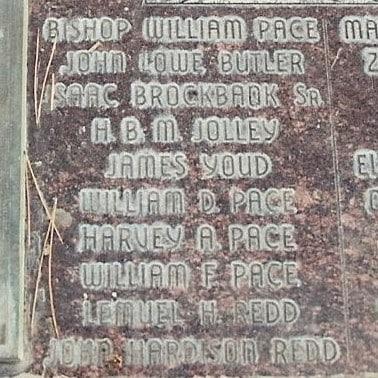
Was he true and faithful to the end after paying such a price to know the truth? Yes. John and his wife gathered with the Saints and in spite of persecutions and hardships endured, remained with the Saints all the way to the Rocky Mountains. Where, accepting a call from the Prophet, John founded the town of Spanish Fork, Utah and served as bishop for the rest of his days. A strong and mighty man of God!
If we can stand the fires of refining as John did—then the Almighty can do great things with us also!
Source: The Autobiography of John Lowe Butler. https://www.familysearch.org/tree/person/memories/KWJC-HXZ