Description
I Never Saw Him Angry: Silas Harris
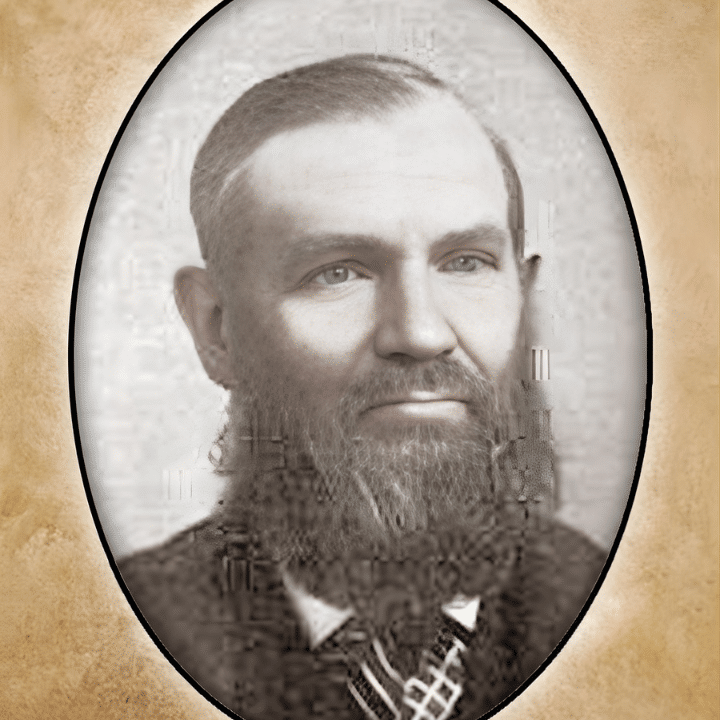
One of those remarkable men of Company B of the Mormon Battalion that did so much for the City of San Diego was Silas Harris. Here is his story.
He was born in 1824, Lawrence County, Indiana, to Moses and Fanny Smith Harris. After a miraculous healing he was baptized into the Church near Far West, Missouri, in 1838, when he was 14.
He was among those persecuted and driven out by the Extermination Order of the Governor. His family settled in Montrose Iowa and built a new farm.
In 1846, Silas enlisted in the Mormon Battalion, and notwithstanding contracting mumps, he marched all the way through to San Diego. After discharge, he returned to his family on the Missouri River. On the way, he met and fell in love with Sariah Aldridge. September 2, 1849, Silas married Sariah at Independence Rock in Wyoming. “They had their wedding dance on the green grassy prairie by the light of the stars and the campfires and to the tune of the fiddle and accordion.”
Silas and Sariah went on to have 12 children and become some of those quiet stalwart Saints–never recognized, who laid firm foundations of faith and community that still stand today. God bless them. But I share Silas’s story because of what his youngest daughter wrote in summary of his life. Please consider this:
“One of the outstanding things I remember about my father is that I never saw him angry. He always said, ‘Problems must be met and difficulties settled with a clear mind.’
I never saw him take a cup of tea or coffee or touch strong drink or taste tobacco. When asked if he would have a cup of tea, he would say, ‘Put in plenty of cream and sugar, and leave the tea out.’
He was a man of sound judgment, kind and considerate, quiet and unassuming. I can see him now as he sat in council with his family. He would say, ‘Know you are right, then go ahead in spite of what people say.’ Also, ‘Drive your work. Never let your work drive you.’
My brothers were mostly sheep and cattlemen. He would say to them, ‘No matter what you have, raise what you consume.’ He took great pride in raising good fruit. Our home was one big orchard. He would send to the Geneva Nursery each year for choice fruits to take the place of the common ones. I remember so well when his big sweet cherries began to bear. They were quite a rare article in Glendale. The town boys enjoyed making raids on them.
One particular night when they were going through the orchard, they had stopped at a pie cherry tree. My father came up to them unawares and said, ‘Boys, you haven’t found the choice ones yet.’ He then led them to the big sweet cherries and told them to help themselves. One of the boys, who afterwards became Bishop of Glendale said, ‘We never bothered Uncle Silas’ cherries again.
He was always kind to animals. JB Carpenter tells of the time when he was coming into town from his home about three quarters of a mile above Glendale on his favorite horse. He was going at a lively speed. As he passed our home, father raised his hand as a stop signal. As JB drew rein, father walked out to the road, looked his horse over, praised him for his many fine qualities, admired the splendid riding outfit, and then, in his quiet, unassuming way, said, ‘But did it ever occur to you that your horse was afoot?’ JB said it made such an impression upon him that he never forgot it.
He furnished employment for a great many people, either with his sheep or on the farm. If anyone came needing help, he always found something for them to do.
Jim Smith tells of his experience with him as a boy. He said it was the first time he had ever worked for anyone. He went out to herd sheep, and, like most boys, he overslept. When he finally waked, the sheep had strayed far away. My father happened to come to camp just as he was getting up. When father noticed Jim’s embarrassment, he said ‘Never mind, Jimmie, nothing so bad, but it could be worse.’ They spent most of the day getting the sheep together again.
Apostle Lyman said of him after his death. ‘There was a man who was prepared to die, having lived a true life.’ Father and mother had 91 grandchildren. Of their eleven children whom they reared to man and womanhood, all were sealed to their companions in the temple.”
I share this question, how would you like to be remembered once you are gone? If we can answer that, then we both know what we have to do. God bless you!
Source:
https://www.familysearch.org/en/tree/person/memories/KWJ8-X1J