Description
Come, Come, Ye Saints
It has been called the “hymn that went round the world.” It is titled Come, Come Ye Saints, and was the anthem of the pioneers who crossed the plains from 1846-1869. Today it is one of the most oft-sung hymns in the Christian world, and not just by Latter-day Saints. Other religions have adapted the hymn and sing it as part of their worship experience.
It was written by William Clayton, an Englishman and a musician, on the morning of April 15, 1846, at the pioneer camping grounds near Locust Creek, Iowa—and this is the story.
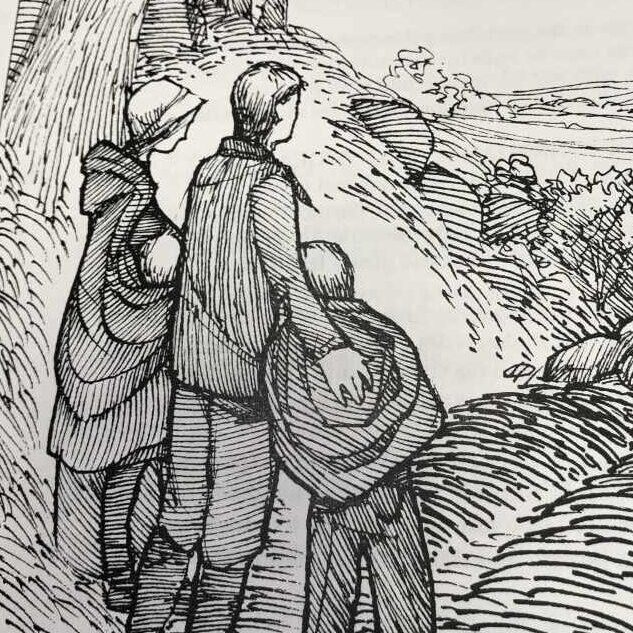
On Friday February 27, 1846, William Clayton crossed the Mississippi River at Nauvoo, Illinois, with his family and all that he owned in several heavy-laden wagons and turned his face to an unknown destination somewhere far away in the West. Heavy on his heart was that remaining behind in Nauvoo was his youngest wife Diantha Farr Clayton. She was only 17 years-old and was expecting her first child. She was too weak and frail to make the journey.
William was one of the clerks of the camp, meaning that it was his responsibility to keep the records and assist the leaders. His presence was needed.
The journey across Iowa has been described thus:
“Although springlike weather facilitated an early departure from Nauvoo, severe weather arose soon thereafter, which both hampered and blessed the already harried exodus. On 14 February it snowed and on 19 February a northwest wind brought eight inches of snow, a very cold night, and “much suffering in the camp, for there were many who had no tents or any comfortable place to lodge: many tents were blown down, some of them were unfinished and had no ends.”
After Brigham Young had left Nauvoo and crossed the river to the Iowa side, the mud became so deep his teams had to be yoked double to pull the wagons up the hill to Sugar Creek camp. A week later the temperatures plummeted and the Mississippi froze over, hastening the abandonment of Nauvoo by allowing numerous Saints to cross on the ice. Because of the extreme cold, however, many people, including Brigham Young and Willard Richards, fell ill at Sugar Creek. Also, several women gave birth in the cold, makeshift camp; they and their new babies suffered most from exposure to the cold, wind, and snow.
Indeed, Brigham Young summarized the daily challenge of the pioneer’s toil when he wrote in his diary that the company had passed through only a mud hole that day “which was about six miles in length.”
Through all of this, William Clayton struggled with the rest, all the while concerned about Diantha and her condition. Letters passed between them. On March 16th, Diantha wrote:
“My beloved but absent William. It rejoiced my heart to hear a word from you….To tell you I want to see you is useless yet true. You are constantly in my mind by day and I dream about you almost every night.
As it was with her, so it was with William. Finally, the Company made camp at rain-swollen Locust Creek, Iowa, 103 miles from Nauvoo. William wrote:
“Last night I got up to watch, there being no guard. This morning Ellen Kimball came to me and wished me much joy. She said Diantha has a son. I told her I was afraid it was not so, but she said Brother Pond had received a letter. I went over to Ponds and he read that she had a fine boy on the 30th. Truly I feel to rejoice at this intelligence…. In the evening the band played, and after we dismissed, we retired to my tent to have a social christening. We had a very pleasant time playing and singing until about 12:00 and drank health to my new son. We named him William Adriel Benoni Clayton.”
It was on that joyous morning of April 15, 1846, that William recorded:
“This morning I composed a new song, ‘All Is Well.’ I feel to thank my Heavenly Father for my boy. I hope that my wife will soon be well.”
William borrowed a tune and title from a popular song of the day called All is Well and taught it to the Saints. It caught hold and from that day to this, it is one of the most beloved hymns of the Church of Jesus Christ of Latter-day Saints.
As the hymn was composed in a moment of joy and exultation, so it is to be sung. It is not a funeral dirge, nor a plaintive cry of despair. It was sung on the trail with vigor, strength, and joy to lift and inspire the soul.
Sources:
http://www.nauvootimes.com/cgi-bin/nauvoo_column.pl?number=101752&author=james-b-allen
https://history.churchofjesuschrist.org/content/museum/museum-treasures-hymns-of-the-trail?lang=eng
https://www.churchofjesuschrist.org/manual/church-history-in-the-fulness-of-times/chapter-twenty-five?lang=eng
https://www.churchofjesuschrist.org/manual/church-history-in-the-fulness-of-times/chapter-twenty-five?lang=eng
http://www.nauvootimes.com/cgi-bin/nauvoo_column.pl?number=101752&author=james-b-allen