Description
Angkor Wat
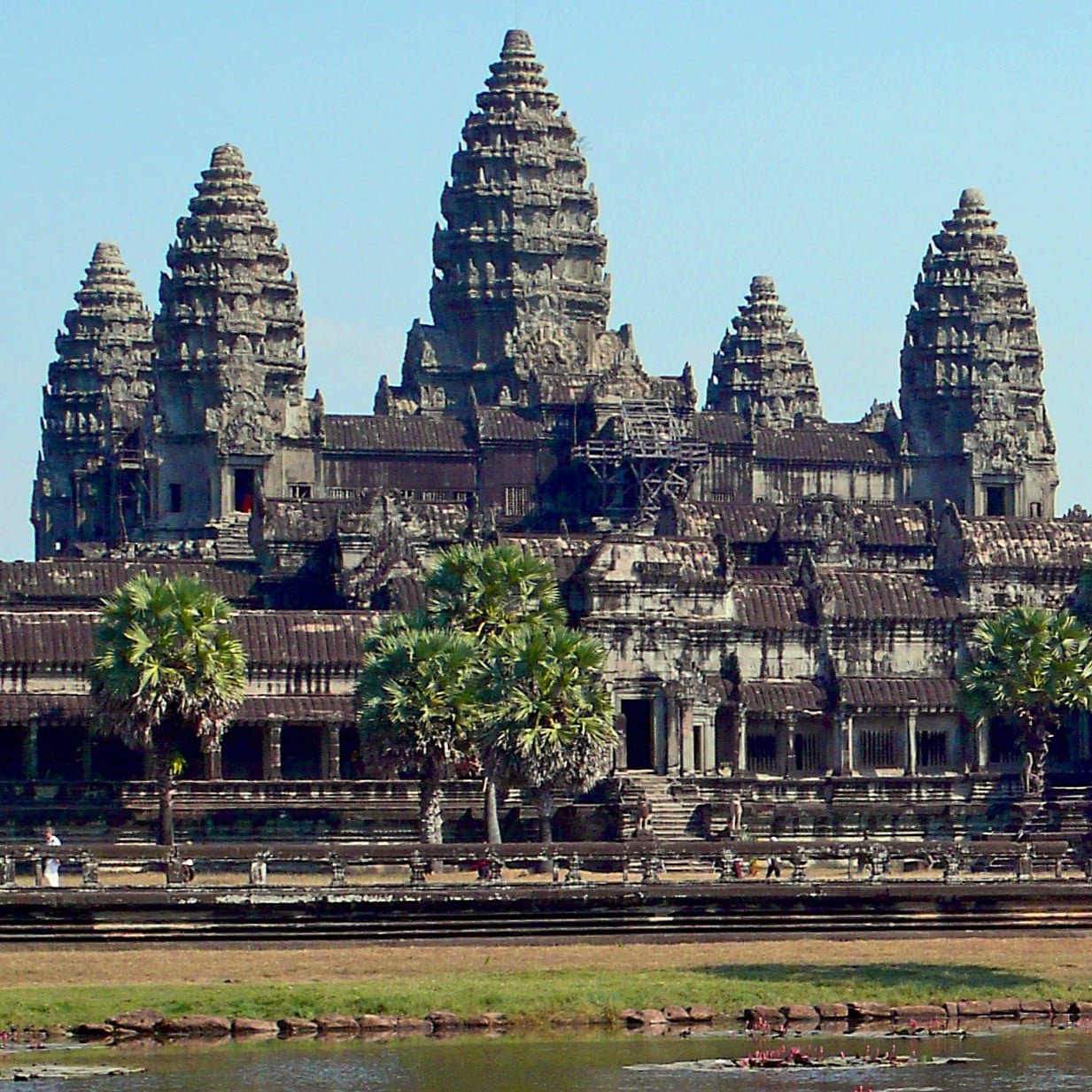
It was 4:45 in the morning and about 80 of us were lined up and seated on a low stone wall running along the west side of the magnificent Angkor Wat temple in Cambodia. I share with you now some of what I shared with them that morning as we waited for the sun to rise over what is the largest religious monument in the world.
Before us was a moat, filled with water, nearly 600 feet wide. Anciently, it represented the cosmic ocean. To cross over that water was to leave behind the ordinary world of mortals and commence a journey into the presence of God.
Right next to us was the causeway by which to enter the sacred mountain, for so the complex was considered. The causeway was the bridge between worlds. Interestingly, serpents lined both sides of the causeway. They were at the very beginning of the journey and were considered guardians of the sacred space.
The ancient ones believed that the serpent was used by Gods and demons in a tug of war to bring forth the cosmos.
As you cross the causeway, you begin a gradual ascent that becomes steeper and more challenging as you reach the center.
After passing through the first gate you enter a large open area that functioned as the garden that existed after the creation.
You walk past two sacred libraries, one on each side of the path. This great temple was considered a center of learning and spiritual knowledge. You are now in what is considered the human world after creation, but the greater journey is yet before you.
As you ascend into the next galleries, the journey becomes more narrow and strict. In these galleries you encounter magnificent and massive carvings on the walls. There you are told the story of the creation of the Universe in the Churning of the Ocean of Milk, and of the war between two brothers—one good and the other corrupt that ultimately leads to the downfall of the latter. This war restores balance and order in the universe. Here you are stepping out of the world you live in and into the heart of the story that explains it.
As you continue forward, you will encounter stairs that are imposing. They are steep—nearly 70 degrees. In order to progress, you have to move slowly, cautiously, with your body leaning forward, your concentration focused. At the top you have now transitioned into another higher and holier sphere. This was considered a space so sacred the public could not enter. It was restricted to royal officials, priests, and the King himself. This was a space of ritual and ceremony that further taught and purified and prepared the individual to proceed into the presence of the divine. It is a space remarkably similar in function to the Holy of Holies in the ancient temple at Jerusalem.
Once here, the glorious central tower is before you with an even more difficult staircase to climb, but once you do, you enter the presence of God himself. When the temple was first constructed nearly a thousand years ago, the Hindu God, Vishnu stood at the center. Now, you will find the Buddha enshrined at its core.
You have now entered the holiest place, the center of the universe—that point where heaven and earth meet.
Here you have come to the end of your journey out of the world. You have the noise and chaos of the mortal world and have entered a quiet realm of stillness. You are a new creature that has found peace and enlightenment.
Angkor Wat was built in the twelfth century by King Suryavarman II to the Hindu God, Vishnu. It was designed and built to be a temple mountain lying at the heart and center of what could have been one of the largest pre-industrial cities on earth.
All I can say is, those who have ears to hear will hear and those who have eyes to see will see. Go and see and for yourself.