Description
A Pioneer Mother
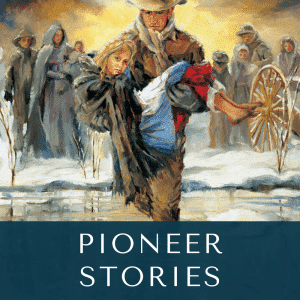
Being a mother is learning about strength you didn’t know you had, and dealing with fears you didn’t know existed. It is no wonder that righteous mothers through the ages have reached out to God for help. This is the story of a determined pioneer mother.
Pernilla Nilsdotter Bom was born in 1818 in Sweden. Her parents taught her from the Bible and she grew to be an intelligent, well-read woman who taught school. In 1844, at the age of 26, Pernilla married Ole Nielson. They lived in Sweden and Denmark, and Pernilla gave birth to eight children—though four died as young children.
While living in Denmark, the family met missionaries from The Church of Jesus Christ of Latter-day Saints, and in 1856, they were baptized. Providing the basic necessities for the family was a struggle. Like many other Scandinavian church members, Pernilla and Ole longed to gather to Zion. The cost to travel with a church sponsored company was $45 for an adult and less for children. Delaying until the whole family could go together would increase the cost.
Their dream of saving enough money for the journey to Utah seemed impossible until Pernilla received a small inheritance when her parents died. However, this was only enough money to pay for part of the family. It was decided that Pernilla and the three youngest children, nine-year-old Swen, six-year-old Lars, and four-year old Sine would join the company leaving that spring. Her husband Ole and oldest son Peter would stay behind in Denmark to work and save money, coming to Utah later. Their tickets were paid that winter.
As spring came, Pernilla faced some new health challenges which would make the trip more difficult, but she resolved to move forward. At the age of 45, on April 30, 1863, she and her three young children joined 600 Scandinavian church members at the Copenhagen, Denmark docks to begin the journey.
The company traveled to England. They boarded the ship B.F. Kimball, and on May 9, 1863, sailed from Liverpool. It was a tough crossing. Shipboard conditions were difficult: overcrowding, disease, seasickness, poor food, and little to do. The family shared one bunk bed. Because of so much sickness on the ship and bad weather, cooked meals were only allowed every three days. The rest of the time they ate dry crackers.
The ship arrived in New York harbor, and on June 15, 1863, they were allowed to disembark and go through customs. They traveled in crowded train boxcars and by steamer, arriving in Florence, Nebraska.
Like many others in their group, Pernilla and her children were exhausted, unaccustomed to the food, and her youngest daughter, along with many others, was sick. Their family was assigned to travel with the John F. Sanders Company, and along with about 250 Saints, left on July 6, 1863.
Fifty wagons, each pulled by four oxen, carried food for travelers, their meager belongings, and merchandise to be sold in Salt Lake. People were expected to walk 20 miles each day, except Sunday. Rations of flour, fat bacon, soda, salt, and pepper were issued twice a week. After walking all day, it was up to Pernilla and the other women to cook for and feed those in their care. Pernilla’s family had no tent, but she managed to sew two sheets together and prop them on forked willows for shelter.
Death was a frequent visitor in the company. After two weeks’ travel, little Sine died at Loup Fork on the Platte River. Her nine-year-old brother Swen wrote years later that, “the only thing they could do was to wrap her little body in a sheet and bury her on the lonesome plains.” After gathering some wild flowers from the hillside for the grave, they left to catch up to the company. It is fitting that Sine’s name is included in the Pioneer Children’s Memorial in Salt Lake and a bronze statue of a boy about Swen’s age is keeping watch next to her name.
Pernilla and her two boys walked every step of the way, and the company arrived in Salt Lake City on September 5, 1863. From there, they traveled another 100 miles south to Fairview, Utah, where she contacted the man who had baptized them in Denmark and asked for shelter.
After traveling thousands of miles, and enduring the grueling journey and death of her daughter, Pernilla’s work was not complete. The health challenges she had worried about the previous winter before departing from her husband were apparent. She was, as the Bible would describe, “great with child”. Three days after arriving in Fairview, this brave mother gave birth to a healthy baby boy who she called Ole, after his father. Two years later, her husband and son joined them.
Pernilla never considered her life remarkable. Yet, her posterity of over 1,300 honors her legacy and has benefited from the choices she made to join the church, come to Utah, and teach her children the gospel. Like the thousands of pioneers who shared her circumstances, she found the strength she didn’t know she had, and with the Lord’s help, faced the challenges of the future with faith.
Written by Jean Tonioli
Sources: