Description
A Monument and a Miracle Part 1 Transcript
First Story: This is the One: Torlief Knapus
The year was 1901. The place was Oslo, Norway or Kristiania at that time. A young college student majoring in art was invited by a group of Latter-day Saint youth to go to a concert, put on by members of the Church. He went and he was so impressed that he decided to start going to Latter-day Saint meetings. Hence, he was baptized, and in 1905 he made a critical decision that he would leave his native Norway and would emigrate to Utah.
No sooner did this young man arrive in Utah, then church officials recognized his talent. He was put to work on the Salt Lake Tabernacle, then the Salt Lake Temple. The decorated frieze in the Salt Lake Temple was done by him. He worked all together, among other things, on the Salt Lake Temple, the Hawaii Temple, the Cardston Temple, the Idaho Falls Temple where he carved the oxen, the Mesa Temple, and the Los Angeles Temple. It is very likely that somewhere in your life and in your travels, you have looked at and admired the artistry of Torlief Knaphus from Norway. Gifted sculptor.
Then, in 1928 or thereabouts, the Church acquired the Hill Cumorah and the Smith farm. No sooner did Torlief learn that the church had acquired these properties than the impression settled upon him that the Church needed to build some kind of a monument there. In fact, he was especially keen on the idea of some kind of monument to Moroni and the Prophet Joseph Smith on top of the Hill Cumorah. Evidently, he didn’t talk to the brethren, he just went to work. He created seven sketches – different designs for the statue atop the Hill Cumorah. From what I can learn, this was a very deeply spiritual man.
He took the seven sketches and one night went up on top of Ensign Peak there in Salt Lake City. He climbed the peak and laid the seven sketches out on the hill and then went before the Lord and asked the Lord in effect, “Am I doing the right thing? Do I have any business doing this? What will the brethren think and if I am doing the right thing, which of these designs is the right one?”
According to multiple accounts from those who knew him, Torlief opened his eyes and light shone brightly all around him. He saw a hand and a finger pointing to one of the sketches and a voice said, “This is the one.” He inquired of the angel who appeared before him and asked: “what should I do now, will the brethren even accept it?” And the angel said, “take these sketches, show them to the brethren and they’ll be waiting for you.”
He did. He went and laid the sketches out, told the brethren his idea and the brethren – did not only commission him to create the statue, but they unanimously picked the exact same sketch that he favored and the angel too.
He went to work on creating that. He’s a sculptor and so the first thing he’s got to do is find a model. He found the model, believe it or not, in a young bricklayer by the name of Elwin Clark who would help build a fireplace in his house. The man had the right physique, the right musculature. He was the man and he said he was going to model the sculpture, but the face was not right. Elwin Clark was too young, so Torlief fasted and prayed and went to the Lord again, asking: “help me find someone to model the face.”
One day, not long after that he was walking around in Salt Lake City and a man walked past him. Something struck him. He followed the man and studied him. Finally, he approached the man and said, “would you be willing to be the model for the face of this unique project?” The man agreed to do it and so together, the two of them walked to Torleif’s studio which was not very far away.
When they walked in, and Elwin Clark was there. Can you imagine Torleif surprise when the two men knew each other. It turned out that the older gentleman was Hiram Don Carlos, Elwin Clark’s father. Father-and-son, models for the angel Moroni atop the Hill Cumorah. It took Torleif five years to complete that, probably longer than most things he’d ever worked on.
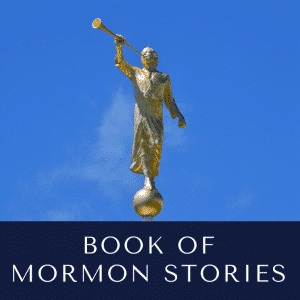
July 21, 1935, that statue was dedicated atop the Hill Cumorah. I’ve been there many times and each time I look up, I am reverently reminded of two things: the angel Moroni and his relationship with the Prophet Joseph Smith and what it meant for Moroni to transfer those records into the hands of Joseph Smith; and the second thing I am reminded each time I look up at that, is that that is a monument and a miracle, designed by revelation, chosen by the same angel it models and modeled by a miracle.
If anybody ever tells you that God is not watching over this work, they are uninformed. He is with us even in the details.
Second Story: Mount Tambora and the Year Without a Summer
April 10, 1815, on the other side of the world on the island of Sumbawa in the Indonesian archipelago, a mountain called Tambora exploded and as it did so, it ejected 38 cubic miles of material 27 miles straight up into the stratosphere and blacked out the sun for two days at a distance of 370 miles around. One of the largest volcanic eruptions in recorded history. The explosion blew off the top 4,700 feet of the mountain and left a crater four miles across.
The force of that explosion was heard 1600 miles away. The pyroclastic flow from that volcano spread out 12 miles in all directions and buried the village of Tambora, freezing in time the inhabitants beneath 10 feet of material. The tsunamis caused by the volcano reached a height of 13 feet, slammed into the surrounding islands and killed thousands. It is estimated that Tambora directly killed 71 thousand people in 1815. Some eleven to twelve thousand were killed directly by the eruption.
Explosions and aftershocks continued for years afterward. High altitude ash was carried up, and prevailing winds around the globe carried that ash all around the earth causing all kinds of strange optical phenomenon – prolonged and brilliant sunsets, stunning twilight’s sunspots, red fog, and all kinds of other things. The following year (1815) would come to be one of the coldest in recorded history. It came to be known as “the year without a summer.”
For example, on June 4th, in the Northeastern United States, a killer frost struck, killing all the crops, snow fell up to a foot. The 1810s became known as the coldest decade on record. Tambora disrupted the lives of millions – plagues, famines, droughts, deaths, destroying crops, intensifying diseases, causing all kinds of terrible aftermath.
Among those whose lives were shattered by this volcano on the other side of the world was a young rural farm of a family living in Vermont. The family had already fallen on hard times and ill health and all kinds of terrible things that happened, reducing the father from being a prosperous landowner to being a simple tenant farmer. Three times in the summer of 1816, he planted his crops and three times they were frozen down by the frost. Finally, that was it. He was ruined. He had had enough of the rugged mountains of Vermont and would seek his fortune on newly opened land to the south and to the west. Accordingly, he moved his family to a new settlement called Palmyra and by so doing, running from disaster, Joseph Smith Sr. moved his young son, Joseph Smith Jr, just two miles from a hill called Cumorah.
The Lord has a talent – a perfect talent – to take all things, terrible disasters, even evil and rotten, and turn the outcome into good. Even in times of plague and natural disaster, the Lord works in the details and somehow a good will come out of this, for you and for me. I don’t know how but I’m confident that it will come.
Third Story: Ole and Marn
This next story I got from friends. Traveling with them, I learned this story and I researched it. This is family history. It comes out of the journals of friends of mine.
Ole and Marn Peterson left Denmark in 1857 to come to Utah. Once they arrived here, they were assigned to the Park Handcart Company, but Marn became ill with an infection in her leg, and it was determined that she would never make it if she continued on across the plains.
So, the Peterson family stayed near Council Bluffs, Iowa and farmed and prepared for that day when they could go on to Zion. In the spring of 1861, they were ready. Finally, they were assigned to a wagon train: Ole and Marn and their four children – Peter, Annie and the two babies, Mary and Joseph.
Somewhere along the trail little Annie became ill. She was six years old. Annie grew weaker and weaker until it was determined she was gone. I don’t know the circumstances but there was danger and urgency along the trail. They didn’t have time to stop and dig a deep grave. They had to wrap her up and place some brush over top of her and run and go on.
Death was no stranger to this wonderful and faithful family. They had already lost three children in their native Denmark and to leave Annie behind was almost more than Ole could bear, but obediently to their captain, they moved on. That night they made camp and, as was customary in those days, around the fire they sang “Come, Come, Ye Saints” or as it was titled then “All is Well.”
The more they sang that refrain, ‘all is well’, the feeling of Marn that all was not well, and she commented to Ole, it was like the Spirit was trying to tell her something.
“Ole,” she said, “I can’t feel that our baby is dead.”
“I know dear, ” said Ole gently. “We had so many plans, but she was and there’s nothing we can do now but pray that we’ll be able to raise the family we have and more when we settle in Zion. Come to the wagon so you will be refreshed for tomorrow’s travel.”
Wearily, Maren started for the wagon. She stopped “Ole, listen to the wolves. Our baby is lying back there alone not even protected by a grave. How can we stand to go on?”
He replied, “We must make up our minds to go on and trust in the Lord for the rest.”
“I can’t, Ole, I just can’t.”
Gently but firmly, Ole took her by the arm and led her back to the wagon. The next morning, when Ole woke up, Marn wasn’t there. She wasn’t in her bed. She wasn’t in the wagon. She was nowhere in the camp. As they searched for her, someone looked out in the distance to the east and spotted someone coming. As she drew near, they realized it was Marn. She came into camp and then they realized she was carrying something. Ole ran to his wife and lifted the burden from their arms. As he spoke to Marn, it struck him that the wrapped burden was Annie and the child was warm – she was alive.
Annie Christina Peterson would recover and live to marry Samuel Wilcox, bear nine children, become a midwife, and bring many children safely in Utah. God be thanked for all of those mothers who, in love and tenderness, never give up on their children.