Description
A Marvelous Work and a Wonder
For this story I am indebted to the research of scholar Keith J. Wilson and his article From Gutenberg to Grandin: Tracing the Development of the Printing Press.
Palmyra, New York began as a single log cabin, built by General John Swift on what would later be called Mud Creek. By 1796, it was incorporated and loftily renamed Palmyra.
The completion of the Erie canal in 1825, instantly transformed the tiny community into a bustling commercial hub.
In 1824, Egbert B. Grandin was 18 years old and the youngest son of a local farmer. He signed on as an apprentice printer at the Wayne Sentinel in Palmyra. By 1827, the 21-year-old Grandin, filled with ambition, purchased the newspaper and moved it to the new and spacious location on Main street.
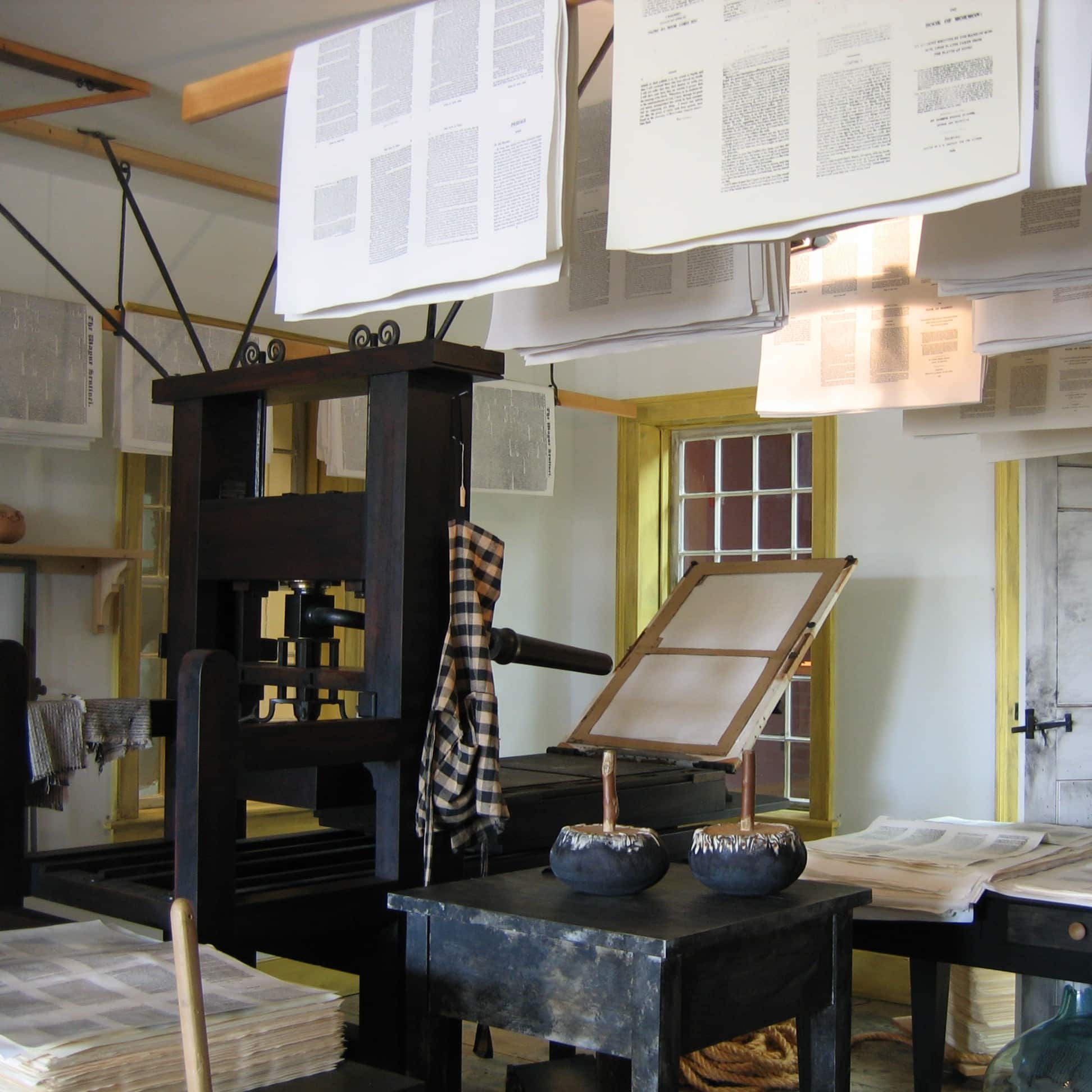
In 1829, he purchased a new state of the art Smith press and had it shipped to Palmyra. It was shipped along the canal and hoisted into place on the third floor of what is today the Grandin Building. As Wilson said it:
“Thus, a daring twenty-one-year-old with little more than a dream purchased a printing shop, moved the business and a costly press into a new and spacious location, and ventured heavily into the printing industry. Some would view these events as providential, others as mere historical coincidences. What is certain is that all this occurred without Grandin’s foreknowledge of the imminent printing of the Book of Mormon.”
By late August 1829, a contract had been struck and with no money forward, Grandin began the printing of the Book of Mormon. Five thousand leather-bound copies were to be completed in 7 months at a cost of $3000. For the day and time it was a huge undertaking—a “mammoth job”.
According to accounts, the printing team worked 11 hours per day, 6 days a week, for 7 months. That would mean approximately 184 days to print the book.
Wilson further explains:
“Sixteen pages were typeset and printed with each pull of the press lever. This meant that for a 592-page book with a run of 5,000 copies, approximately 2,960,000 pages had to be printed. In layman’s terms, the printing lever on this rugged Smith press would have been pulled at least 185,000 times during this seven-month period. It would have necessitated more than a thousand pulls per day. But this was not all. To print each sheet of paper, two skilled pressmen had to quickly perform nine other separate tasks. After the printing pull, these other nine steps were as follows: crank the bed back to its original position, lift up the frisket assembly, lift the frisket bracket and remove the sheet, hand ink all sixteen pages in the composite layout, lift the frisket bracket, register the sheet on the timpan bracket, lower the frisket bracket back into place, swing the frisket basket down on the inked layout, and crank the removable bed under the platen. Completing these tasks meant that one of the 185,000 pulls had been completed. On a daily basis, these tasks had to be repeated more than one thousand times. However, this printing procedure constituted only a fraction of the effort to actually produce the book. The type and spacers, which totaled over 42,500 individual pieces for each form, had to be typeset thirty-seven different times. (The total number of pieces set during the seven months was more than 1.5 million.) The entire manuscript also had to be punctuated by the typesetter. Next, the printed sheets had to be hung and dried, after which the thirty-seven signatures were folded, cut apart, and stitched together for each book. Finally, a binding was applied to the 592 pages. For a small frontier newspaper, this 184-day process was nothing short of phenomenal.”
At just the right time and in the most unlikely of places, the Book of Mormon came forth to the world, driven by the insatiable ambition of two very different men. Keith Wilson summarized the miracle this way:
“Anciently the Lord, through the prophet Isaiah, foretold the day when He would “do a marvellous work among this people, even a marvellous work and a wonder” (Isaiah 29:14). Often the Latter-day Saint interpretation of this passage points to the Book of Mormon in its entirety, a marvelous manifestation in this last dispensation. But what if Isaiah was also foretelling the marvelous physical manner in which this marvelous work would be brought forth? To those who have come to believe, the timely events from Gutenberg to Grandin that facilitated the printing of the Book of Mormon might be yet another evidence of God’s hand in this marvelous work and a wonder.”
Sources:
https://en.wikipedia.org/wiki/E._B._Grandin